
Hair that is too short for an MPU is a common problem when proof of abstinence through hair analysis is planned. Many people realise too late that their hair is not long enough for alcohol or drug testing. This can cause delays, additional costs and uncertainty before the MPU.
It is therefore essential to understand minimum lengths, when body hair may be considered and the available alternatives early on. Knowing the rules helps you plan your proof of abstinence and avoid unnecessary setbacks.
Key points
- MPU hair analysis usually requires 3 cm of scalp hair for alcohol and up to 6 cm for drugs.
- Scalp hair grows by an average of about 1 cm per month, so 3 cm generally corresponds to three months and 6 cm to around six months.
- If hair is too short, the analysis may fail or not be performed at all.
- Body hair may be used exceptionally for drug testing, but is not standard for alcohol.
- Alternatives such as urine or saliva tests can help when scalp hair is too short or there are doubts about its suitability.
What happens at the MPU if scalp hair is too short?
If scalp hair is too short for MPU hair analysis, proof of abstinence often cannot be provided through hair as planned. Alcohol testing typically requires 3 cm of scalp hair, and drug testing up to 6 cm. If the hair is not long enough, alternatives such as urine or saliva tests are usually recommended. Body hair may be used for drug testing in individual cases, but is considered more complicated and accepted less often.

Read more about this topic: Getting hair free of drug residues
When short scalp hair becomes a problem for the MPU
Short scalp hair is particularly problematic for the MPU when proof of abstinence through hair analysis is planned. This method is frequently used in Germany to demonstrate abstinence from alcohol or drugs. The problem begins when the required hair length is unavailable. For alcohol, 3 cm of scalp hair is typically sufficient.
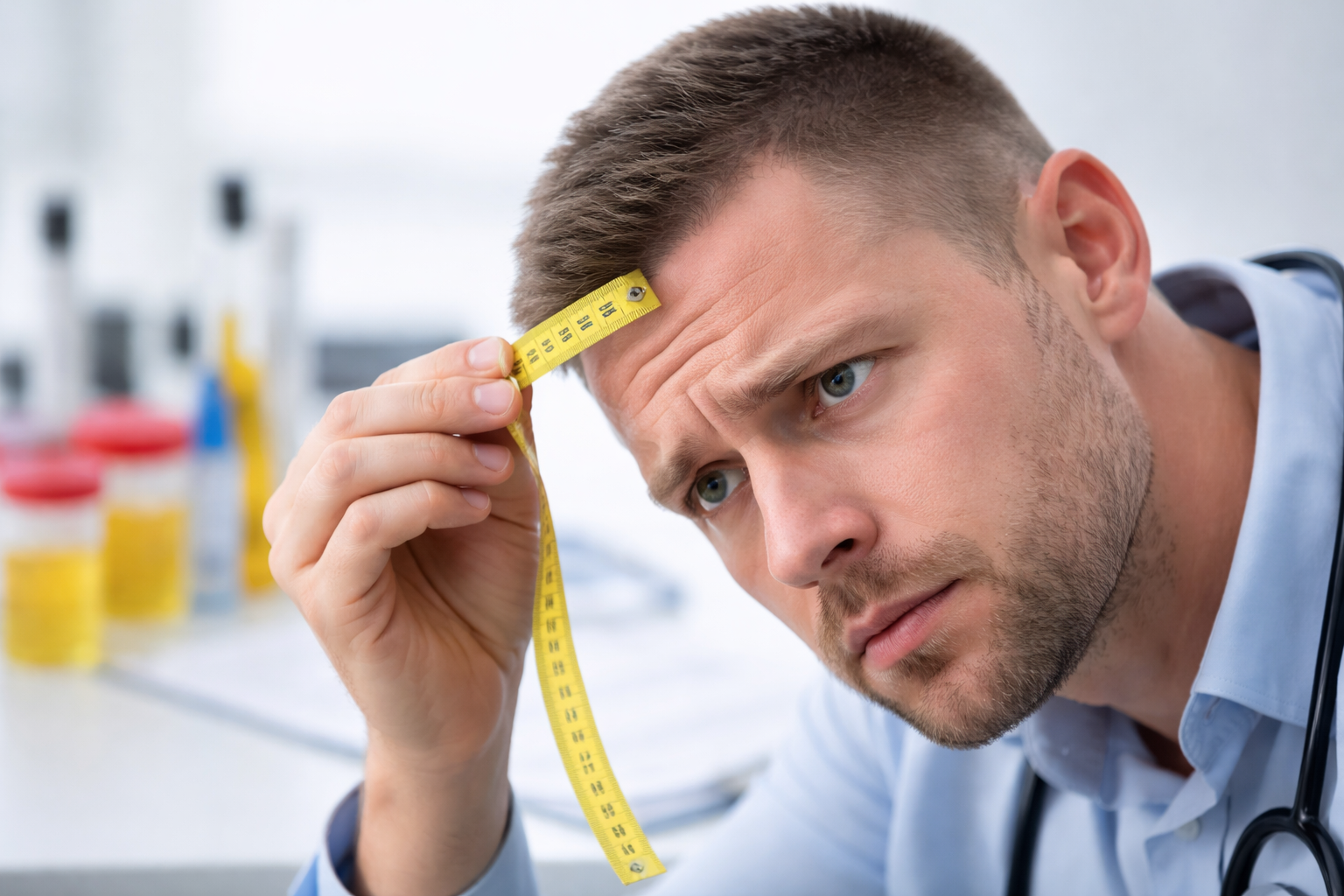
For drugs, up to 6 cm is often needed. The reason is simple: scalp hair grows by an average of about 1 cm per month. Without the necessary length, the desired period cannot be represented reliably. People should therefore check early whether their hair is sufficient for the planned evidence.
What hair length is required for alcohol and drugs?
For the MPU, the requirement depends on the substance being tested. Alcohol testing generally requires 3 cm of scalp hair, corresponding to approximately three months. Drug testing may require up to 6 cm.
This represents about six months of evidence. These differences matter because many people assume the same requirements apply to both, which is incorrect. Anyone needing drug-related evidence usually requires more hair material and more planning. Precise coordination with the assessment centre or laboratory is therefore particularly important.
| Type of evidence | Typical scalp hair length | Approximate period |
|---|---|---|
| Alcohol | 3 cm | 3 months |
| Drugs | Up to 6 cm | 6 months |
Why hair analysis often fails when hair is too short
Hair analysis needs enough material to assess the desired period reliably. When hair is too short, there is no basis for complete evidence, and the laboratory cannot properly examine the relevant section.
In practice, this often means that the analysis is not recognised or cannot be performed at all. This is particularly frustrating because time is lost, and MPU preparation may be significantly delayed. Discovering shortly before an appointment that your hair is too short quickly creates pressure. Hair length is therefore a central part of overall abstinence planning, rather than a minor detail.
Is body hair a real alternative for the MPU?
Body hair may be an alternative in exceptional cases, but it is not the standard solution. Examples include underarm, chest or leg hair. These types of hair may be used for drug testing under certain circumstances.
However, this is not considered the usual standard method for alcohol. This important distinction is often overlooked. Anyone considering body hair should not assume it will automatically be accepted. Assessment is also more complicated. Experts therefore advise caution when considering body hair as a substitute for scalp hair.
| Hair type | Suitability for alcohol | Suitability for drugs | Special feature |
|---|---|---|---|
| Scalp hair | Commonly used | Commonly used | Standard for testing |
| Underarm hair | Not usable | Possible in exceptional cases | Grows more slowly |
| Chest hair | Not standard | Possible in exceptional cases | More complicated assessment |
| Leg hair | Not standard | Possible in exceptional cases | Accepted less often |
How body hair growth and detection periods are assessed
Body hair does not grow as uniformly as scalp hair, making interpretation more difficult. According to the figures cited, underarm hair grows more slowly, at around 0.3–0.5 cm per month.
Chest and leg hair grow at a similar rate or slightly faster than underarm hair, sometimes closer to the rate of scalp hair. Nevertheless, detection periods are generally shorter or harder to interpret. Body hair is therefore less often preferred. For the MPU, having hair available is not the only consideration.
The period must also be traceable and assessed to sound professional standards. This is where the use of body hair fails in many cases.
| Hair region | Approximate growth rate | Significance for testing |
|---|---|---|
| Scalp hair | Around 1 cm/month | A readily planned period |
| Underarm hair | Around 0.3–0.5 cm/month | Slower and harder to interpret |
| Chest hair | Similar or slightly faster | Variable detection period |
| Leg hair | Similar or slightly faster | Variable detection period |
Practical solutions when scalp hair is too short
There are several sensible options when scalp hair is too short. The simplest is often to let it grow. With enough abstinence time available, you can reach the required 3–6 cm. Depending on the target, this usually takes several months.
Urine testing is another option. It is independent of hair length and considered a reliable alternative. Saliva tests may also be useful in suitable cases. For dyed hair and drug testing, a combination of hair analysis and urine monitoring may be appropriate.
These strategies help avoid MPU delays and plan evidence properly.
How to avoid delays with the MPU
The most important step is early planning. As soon as you know that proof of abstinence will be needed, pay attention to hair length. This is particularly important for drugs, where up to 6 cm of scalp hair may be required.
Last-minute decisions shortly before the MPU are often risky. It is better to start early with a clear strategy, including learning about alternatives such as urine or saliva tests. Body hair should be considered cautiously as a solution.
Planning in good time usually saves time, money and stress. When dealing with hair that is too short for an MPU, proper preparation matters just as much as the analysis itself.
Body hair analysis as an alternative for short hair
When scalp hair lacks the required length, hair analysis for the MPU is often also possible with body hair. Chest, arm or leg hair is usually used. It is important to know that these hairs grow significantly more slowly than scalp hair, making the detectable period harder to determine.
Underarm hair is usually not permitted for EtG alcohol testing because of sweat gland activity and potential contamination. Anyone wondering what to do when hair is too short should always agree the use of body hair with the laboratory or MPU centre beforehand.
Not every laboratory accepts these samples because forensic comparison of growth rates is more complex. Nevertheless, for many people they provide a last resort for obtaining proof of abstinence in time.
Forensic pitfalls: dyed and bleached hair
Chemical treatment is a critical issue in MPU hair analysis. Many people wondering what to do if their hair is too short decide to grow it while continuing cosmetic treatments.
However, caution is necessary: forensic laboratories often reject bleached, dyed or chemically straightened hair under CTU criteria. Chemicals can wash out or alter incorporated drug or alcohol (EtG) residues, making the result unusable. In such cases, the hair is legally treated as unavailable for the evidence period.
If your hair has been treated, you often need to let untreated hair grow out before a sample can be collected. Include this delay in your MPU preparation so that you do not miss deadlines.
A seamless switch to a urine monitoring programme
If hair remains too short or there is insufficient time to grow it, switching to a urine monitoring programme is the remaining option. To replace MPU hair analysis, the programme must be documented without any gaps.
Anyone asking what to do if their hair is too short should immediately sign up for urine sampling to avoid interrupting the evidence period. Switching is possible at any time, but the first urine sample must be collected promptly after the insufficient hair length is identified.
Ensure that the laboratory is accredited to DIN ISO/IEC 17025 so that the MPU centre accepts the urine tests. This secures your abstinence period even if your hair is temporarily too short for analysis.
Conclusion
Hair that is too short for an MPU can make proof of abstinence much more difficult, but it need not cause a setback. Understanding minimum lengths, planning alternatives such as urine or saliva tests and realistically assessing body hair can help avoid delays. Early planning is crucial to build the right evidence in time. Taking this seriously significantly improves your chances of a smoother MPU process.
Sources:
- Frequently Asked Questions About Proof of Abstinence Through Hair Analysis – TÜV Hessen
- Hair Analysis for Alcohol and Drug Testing for the MPU
- Hair Sample Collection for Fitness-to-Drive Assessment and the MPU
FAQ
Is 2 cm of hair sufficient for MPU hair analysis?
For alcohol abstinence, 3 cm is usually required to cover three months. The laboratory can analyse shorter hair, but the evidence period is correspondingly reduced to only two months.
Can I avoid hair analysis by shaving my head?
Assessors often regard shaving the hair as attempted manipulation or a lack of cooperation. In this case, you must switch to a considerably more demanding urine monitoring programme.
Why is underarm hair prohibited for alcohol testing?
Underarm hair comes into intensive contact with sweat, which can wash out or concentrate ethyl glucuronide (EtG). Under CTU criteria, it is therefore not permitted for proof of abstinence admissible in court.
How quickly does hair grow on average for MPU purposes?
Forensic practice uses a standard growth rate of exactly one centimetre per month. Individual variations are usually not considered for the MPU in order to ensure consistent assessment.
What happens if my hair is dyed or bleached?
Bleached or dyed hair is unsuitable for hair analysis because chemical treatment destroys incorporated substances. You must wait until untreated hair has grown back to a sufficient length.
Can I combine hair analysis and urine tests?
Yes, combining them is possible, for example to bridge a gap caused by short hair. The important requirement is seamless documentation of the transition between the methods.
How much hair is actually cut off for the sample?
Usually, two or three bundles about as thick as a pencil are taken. This is generally done at the back of the head so that the sampling site is barely noticeable cosmetically.
How long can drug use be detected in 6 cm of hair?
A 6 cm hair segment can provide uninterrupted documentation of consumption over the previous six months. This is also the maximum period recognised per hair analysis for drugs.
Can a special cleansing shampoo help me pass the analysis?
Professional laboratories detect chemical manipulation of hair structure very reliably. Such attempts generally lead to an unfavourable assessment because of attempted deception.
Do I need to fast before a hair analysis appointment?
No, fasting is not necessary for hair sample collection. Simply make sure your hair is freshly washed and free of styling products.