
There can be various reasons for taking a drug test at home. Parents may, for example, want to find out whether their child is using drugs. Testing for abstinence yourself can provide clarity if you suspect that someone has drugged you without your knowledge.
A hair test can identify whether drugs such as cocaine, heroin or the THC contained in hashish are present in your body. A test can be obtained from a pharmacy, online or from a specialist laboratory. To carry out the test, first disinfect the scissors you will use, then take a pencil-thick hair sample approximately four centimetres long from the person concerned.
Place the hair in the envelope supplied with the test, seal it and post it to the laboratory. The sample is analysed there, and the result is sent by post or email after a few days. If the test is unexpectedly positive, consult a medical professional. They can perform another test to rule out a possible laboratory error.
Direct contact: +49 171 4107688
Get your proof of abstinence hereBy EMAIL: Kontakt@Abstinenznachweis.com
Where can I buy an EtG hair test for alcohol?
EtG is one of the two alcohol markers found in human hair after alcohol consumption. Testing for it is not limited to certified official tests, such as proof of abstinence for an MPU.
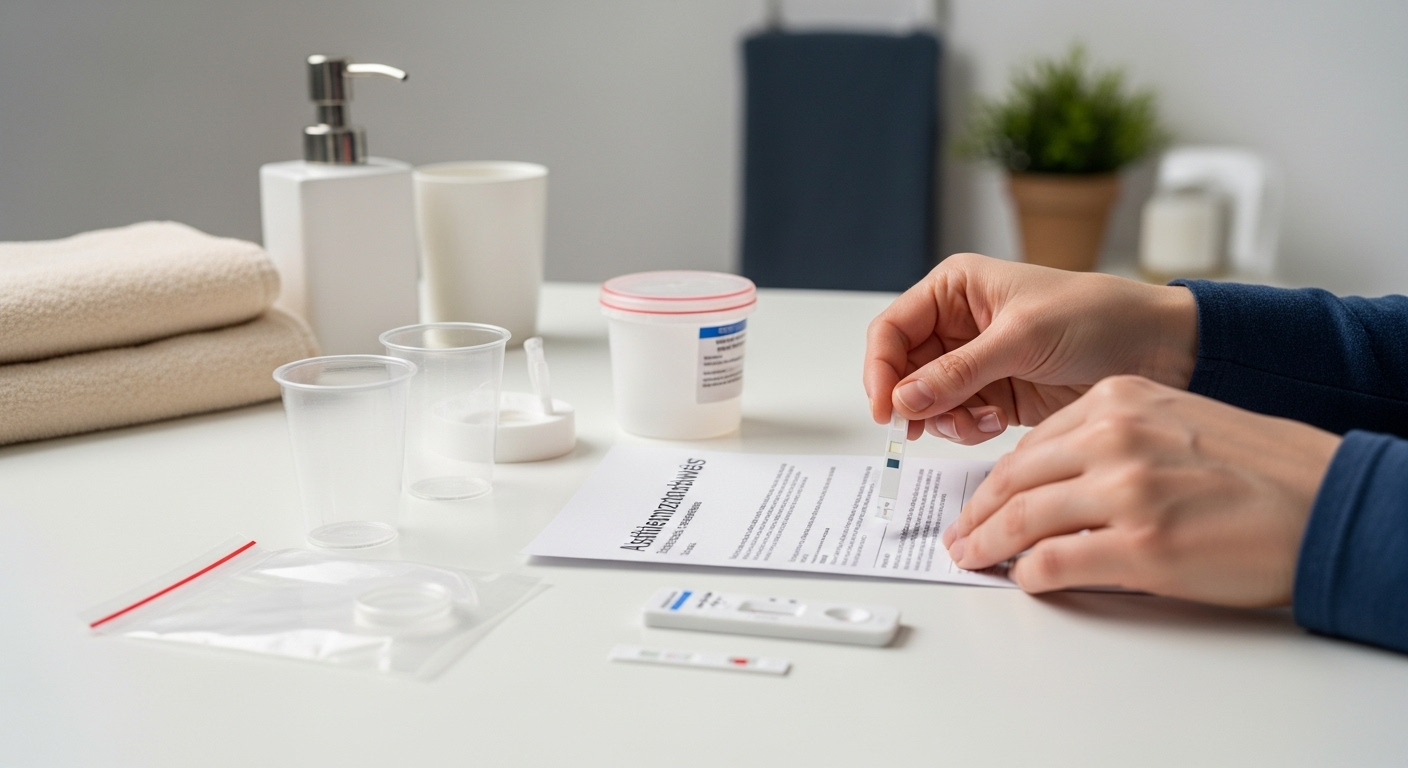
There are also tests for people wishing to test for abstinence themselves, available online, from a GP, a pharmacy or a laboratory. Depending on the supplier, a hair analysis kit may be certified or non-certified. For personal information alone, a non-certified test is usually sufficient. It often costs less than its certified equivalent.
However, one rule always applies: the result of a self-administered test is not officially recognised. It therefore cannot replace official proof of abstinence before an MPU, which must be obtained through a specialist medical practitioner or a recognised assessment centre.
Where can I buy a hair analysis drug test?
While the use of most drugs is illegal in this country, drug testing is not. A rapid drug test kit can, for example, be bought at a pharmacy. Such a kit can readily detect consumed amphetamines, opiates, THC and cocaine.
Various multi-drug tests can also be purchased online. Their prices range from five euros to several hundred euros. However, it is questionable whether every test on offer is reliable.
Alternatively, a doctor can carry out a drug test. Although this costs more than a purchased self-test, you can rely on the result. The doctor is also bound by medical confidentiality, so you do not need to worry about your job or driving licence, for example.
Where can I have a private hair analysis?
Having a private hair analysis means contacting a testing centre voluntarily and on your own initiative. Such centres may include organisations that also conduct MPU or fitness-to-drive assessments.
Your GP is also a useful contact for an analysis of this kind. However, bear in mind that the result will not be officially recognised, for example as proof of abstinence before an MPU. Recognition applies only if the doctor carrying out the test holds the relevant additional qualification.
Specialists in forensic or traffic medicine, for example, may perform an officially recognised hair analysis. The same applies to proof of abstinence obtained through a recognised laboratory.
Where can I obtain proof of abstinence?
There are several ways to obtain proof of abstinence. The following are the most obvious options.
- In many, but not all, cities, the public health department offers abstinence testing. It is often cheaper there than elsewhere. Alternatively, the department can usually provide details of places that offer the service.
- You can find specially approved laboratories in your region online. Since every procedure involves several testing appointments, it is best to choose a laboratory near your home or workplace.
- MPU assessment centres also offer abstinence testing in most cases.
It is important that abstinence is certified by a provider specifically approved for this purpose. If in doubt, obtain confirmation beforehand to avoid unnecessary expense and losing valuable time. Evidence obtained from a provider that is not approved for this purpose cannot be recognised.
The chain of custody: why self-documentation is not possible
The idea of providing proof of abstinence yourself fails because of the mandatory principle of the forensic chain of custody. For an MPU, the evidence must be legally admissible, meaning that certified staff must document the entire process continuously, from sample collection to analysis.
This includes identity verification, observation during sample provision to prevent tampering, and immediate sealing of the sample. Any self-administered test would break this chain, and the MPU assessor would immediately reject the evidence.
The role of PEth blood analysis as an alternative for alcohol
In addition to urine and hair analysis, there is another advanced option for proving alcohol abstinence: the PEth blood test for phosphatidylethanol. Blood PEth levels can reveal alcohol consumption over the preceding 2 to 4 weeks and are considered highly reliable.
Although you cannot provide official proof of abstinence yourself, this method offers strong protection against tampering and is recognised by MPU centres. It often serves as an additional or alternative method when hair analysis is not possible, for example.
Recognition of the evidence and the legal basis
Strict adherence to Annex 14 of the German Driving Licence Ordinance (FeV) and the CTU criteria is decisive for the validity of your proof of abstinence. Evidence you supposedly obtain yourself is recognised only if it is produced under forensic conditions by an accredited provider, such as TÜV, DEKRA or medical laboratories accredited to ISO 17025.
Failure to comply with these legal requirements inevitably invalidates the assessment and delays the restoration of your driving licence.
Sources:
- TÜV NORD: Proof of Abstinence – MPU
- SYNLAB: Proof of Abstinence for MPU Assessments
- MPU-Akademie: MPU Proof of Abstinence: Are 6, 12 or 15 Months Necessary?
FAQ
Can I provide my own proof of abstinence for the MPU?
No. You cannot provide proof of abstinence for the MPU yourself, because only evidence from certified providers is recognised. The entire process must take place under forensic conditions with continuous documentation.
Where must I register for official proof of abstinence?
You must register with an officially recognised provider, such as a fitness-to-drive assessment centre (BfF), including TÜV or DEKRA, or a laboratory certified according to the CTU criteria. These providers ensure compliance with all legal requirements.
Why is a self-administered drug test not accepted?
A self-administered test is not accepted because the sample’s forensic chain of custody is not guaranteed and tampering is possible. The test subject’s identity and the sample’s integrity must be attested by an assessor.
How long must I demonstrate abstinence?
The period is generally 6 or 12 months, depending on the seriousness of the original offence and the traffic psychologist’s recommendation. In rare cases, 15 months may be necessary.
Which is better for proof of abstinence: urine or hair analysis?
Both methods are equivalent and recognised, but the choice depends on the duration of abstinence and your hair length. Hair analysis provides a longer retrospective window, while urine testing requires unannounced checks at short notice.
Can I dye my hair if I am proving abstinence through hair analysis?
Dyed or bleached hair is not permitted for alcohol hair analysis because this can distort EtG levels. For drug analysis, dyeing is often tolerated only for the first test after consultation; untreated hair is required afterwards.
How often must I provide urine samples to demonstrate abstinence?
A 12-month programme generally requires 6 unannounced urine tests during that period. A 6-month programme usually requires 4 urine tests.
What happens if I miss a urine sampling appointment?
Missing a urine sampling appointment is often treated as a positive test and invalidates the entire abstinence programme. Scheduling flexibility and availability are therefore essential throughout the programme.
What is the PEth test, and is it valid proof of abstinence?
The PEth test is a blood test for the alcohol marker phosphatidylethanol and is recognised evidence of alcohol abstinence. It is mainly used when hair analysis is impossible or to document controlled drinking.
Can my GP provide proof of abstinence for me?
Generally, a GP may not carry out forensic abstinence testing for the MPU, because this requires special accreditation under DIN EN ISO/IEC 17025. You must attend a certified collection centre.