

Dyeing, bleaching or straightening your hair can seriously jeopardise proof of abstinence obtained through hair analysis. Many people underestimate the fact that chemical treatments change the structure of the hair and can therefore affect laboratory results. Modern laboratories examine hair samples very carefully and detect changes to the hair structure caused by tampering.
Bleaching with hydrogen peroxide in particular significantly changes hair morphology. This can remove drug metabolites such as THC that have been incorporated into the hair. Although this could theoretically lead to lower readings, laboratories usually interpret it as an attempt to manipulate the results. In practice, this can mean that the hair sample is not accepted and proof of abstinence cannot be established.
Key points at a glance
• Chemical hair treatments can invalidate proof of abstinence obtained through hair analysis.
• Bleaching destroys parts of the hair structure and can release incorporated drug metabolites.
• Laboratories detect such changes through microscopic analysis or chemical markers.
• Under the Society of Hair Testing criteria, bleached or heavily treated hair is often rejected.
• Hair should remain untreated for at least 3–6 months before analysis.

Can dyeing or bleaching affect hair analysis for proof of abstinence?
Yes. Chemical treatments such as bleaching, dyeing or straightening change the hair structure. As a result, some incorporated drug metabolites can be lost. However, laboratories frequently detect these changes and reject samples that have been tampered with. Treated hair is therefore often considered unsuitable, particularly for MPU abstinence testing.
Read more about this topic: Finally getting drug-free hair
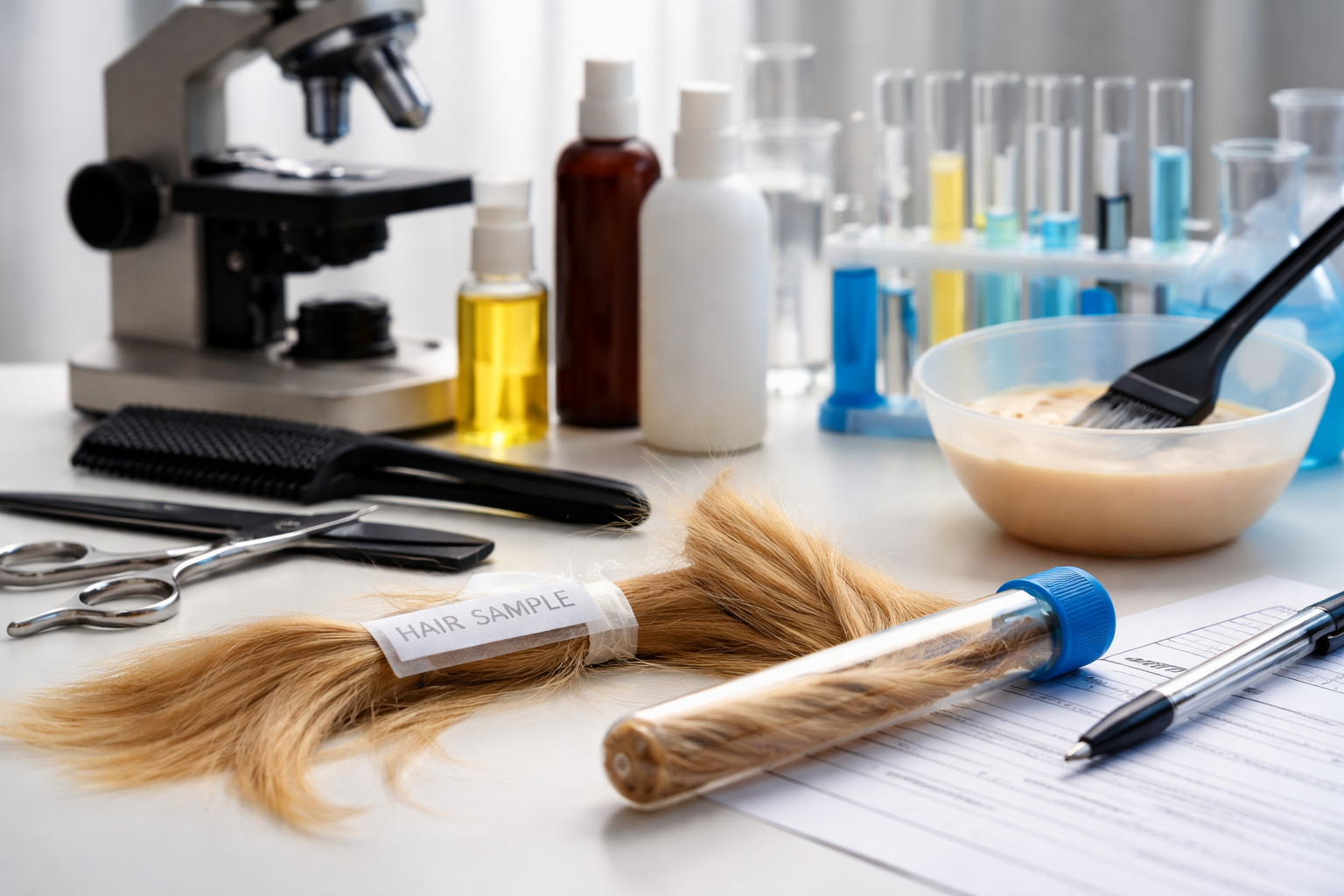
Why hair analysis is used to prove abstinence
Hair analysis is considered a particularly reliable method of detecting long-term drug or alcohol consumption. Unlike urine tests, it can cover a considerably longer period. Hair grows by an average of around one centimetre per month.
The hair’s length therefore allows a period of several months to be examined retrospectively. As hair grows, substances’ metabolic products become incorporated into it. These so-called metabolites remain stored there in a stable form.
Examples include THC metabolites or ethyl glucuronide following alcohol consumption. In medical toxicology, hair is therefore regarded as a long-term biological archive. This method is frequently used in medical-psychological assessments such as the German MPU.
It is considered relatively difficult to falsify. Nevertheless, some people try to influence the result through cosmetic treatments. This is precisely why laboratories examine the hair structure so carefully.
How bleaching changes the hair structure
Bleaching is one of the strongest chemical treatments for hair. Hydrogen peroxide is usually used. This substance penetrates deep into the hair and opens its outer cuticle layer.
At the same time, it oxidises colour pigments inside the hair, making it lighter. However, this process also alters the hair matrix, which is where drug metabolites such as THC are incorporated.
If the matrix is damaged, some of these residues can escape from the hair. Specialists describe this as substances “bleeding out” of the hair. This reduces the concentration of metabolites in the hair.
In theory, this can produce a negative test result even though consumption has occurred. However, laboratories are aware of this effect. They therefore assess bleached hair particularly critically. Major structural changes are frequently interpreted as tampering.
How laboratories detect chemical tampering
Modern toxicology laboratories have various methods for identifying hair samples that have been tampered with. Microscopic examination is an important step. The hair is examined under a light microscope.
Changes to the cuticle or hair structure can be readily identified in this way. Chemical markers can also be examined. One example is pyrrolidone carboxylic acid, also referred to as PTCA. This substance forms during oxidative processes in the hair.
It is therefore considered an indicator of strong chemical treatments such as bleaching. Finding these markers suggests that the hair structure has been altered. In many cases, laboratories interpret this as an attempt to manipulate the results.
The hair sample can then no longer be used to prove abstinence. This applies particularly to official tests for public authorities or courts.
How dyeing affects drug detection in hair
Dyeing can also change the hair structure. Hair dyes generally contain chemicals that penetrate deep into the hair, open the cuticle and change the pigment structure.
This process can also cause some incorporated metabolites to be lost, although the effect is often less pronounced than with bleaching.
Nevertheless, the concentration of drug residues in the hair may fall. This is problematic for laboratories, which must ensure that proof of abstinence is reliable. Heavily dyed hair is therefore assessed critically.
Strict criteria apply particularly when testing for alcohol markers such as ethyl glucuronide. Under international standards, coloured hair may be classified as unsuitable in certain circumstances. In such cases, a new sample is required.
Straightening and heat as additional risk factors
In addition to bleaching and dyeing, straightening can also play a role. High temperatures are often used, and some procedures also involve chemical straightening products.
These can also change the hair structure. Heat can damage the outer cuticle, while chemical straighteners also attack the hair’s protein structure.
This can release substances incorporated into the hair. Although the effect is usually weaker than with bleaching, it can still affect laboratory analysis. The risk increases considerably when several treatments are combined.
An example is dyeing and straightening the hair at the same time. In such cases, laboratories often detect structural changes. Here too, the hair sample may be classified as having been tampered with.
Laboratory practice for MPU assessments and proof of abstinence
Particularly strict requirements apply to medical-psychological assessments. Proof of abstinence must be clear and verifiable. Laboratories therefore examine the hair sample very carefully.
If the hair has been chemically treated, the sample may be rejected. An alternative form of evidence is then frequently required, often involving regular urine tests. Modern analytical methods can also detect very low concentrations.
For the THC metabolite, for example, the cut-off is approximately 0.02 ng per milligram of hair. Despite such sensitive methods, cosmetic treatments can distort the result. Experts therefore recommend avoiding hair treatments for several months before hair analysis.
As hair grows by around one centimetre per month, a three-centimetre segment corresponds to roughly three months of testing history. To be on the safe side, you should therefore avoid chemical treatments for at least three to six months before sampling.
The influence of cosmetic treatments on hair analysis
| Treatment | Effect on the hair | Effect on drug detection |
|---|---|---|
| Bleaching | Destroys the hair matrix through oxidation | Significant loss of metabolites is possible |
| Dyeing | Opens the cuticle and alters pigments | Residue concentrations may decrease |
| Straightening | Heat or chemicals alter the hair structure | May release some metabolites |
| Untreated hair | Structure remains stable | Most reliable conditions for analysis |
CTU criteria: why the laboratory rejects a sample
A crucial aspect of dyeing, bleaching and straightening: can hair cosmetics invalidate my proof of abstinence? is the so-called CTU criteria. These forensic guidelines stipulate that only hair in its natural, untreated state may be used for legally valid proof of abstinence.
Once the laboratory identifies a chemical alteration to the hair structure caused by bleaching or dyeing, the fitness-to-drive assessment criteria often mean that the sample may no longer be analysed. The laboratory then issues a certificate stating that the sample cannot be used.
For you, this means that even if no drugs were found, abstinence is not considered proven, because the chemical treatment might have artificially reduced the concentration of substances inside the hair.
The EtG washout effect caused by harsh cosmetics
The situation is particularly critical for the alcohol marker EtG (ethyl glucuronide). Anyone asking “Can hair cosmetics invalidate my proof of abstinence?” needs to understand that, unlike many drugs, EtG is highly water-soluble.
Chemical treatments such as bleaching, perming or frequent straightening open the hair cuticle very widely. This can effectively wash incorporated EtG out of the matrix. In an MPU assessment, such a finding is often interpreted not as “negative”, meaning abstinent, but as an attempt to manipulate the result.
The destruction of markers by cosmetics means that the entire hair period affected by the treatment can no longer be used as evidence of alcohol abstinence.
The serious gap in evidence during the abstinence period
The greatest danger with chemically treated hair is not necessarily a positive result, but the resulting gap in evidence. If you dye, bleach or straighten your hair, you risk the laboratory rejecting the sample as “unsuitable for forensic use”.
Because an MPU usually requires continuous proof over 6 or 12 months, a single “ruined” hair sample can invalidate the entire period. You may then have to start again from scratch, because the assessor cannot determine what was consumed during the three months affected by the hair treatment.
Avoid chemical experiments so that cosmetic procedures do not jeopardise the abstinence period you have worked hard to establish.
Conclusion
Cosmetic hair treatments can significantly affect hair analysis. Bleaching, dyeing or straightening change the hair structure and can remove some incorporated metabolites. However, modern laboratories usually detect such changes reliably. In many cases, the sample is then classified as having been tampered with and is not accepted. This can be particularly problematic for MPU abstinence testing. Anyone who needs reliable proof should therefore avoid chemical treatments for several months before sampling.
Sources:
- FAQ: Proof of Abstinence Through Hair Analysis
- Hair Sampling for Fitness-to-Drive Assessments and MPU
- Frequently Asked Questions About Proof of Abstinence Through Hair Analysis – TÜV Hessen
FAQ
May I dye my hair during an abstinence programme?
Under the official CTU criteria for the MPU, hair must be in its natural state for hair analysis. Chemical dyes may cause the laboratory to reject the sample as unsuitable.
What happens if I bleach my hair despite needing proof of abstinence?
Bleaching damages the hair structure so severely that incorporated substances such as EtG or drug markers can be washed out. Assessors frequently interpret this as attempted manipulation of the result, invalidating the entire proof.
Can I still prove abstinence with tinted hair?
Tints can also influence the analysis, as they coat the hair or penetrate it slightly. It is generally recommended to avoid any chemical alteration throughout the entire testing period.
Can the laboratory detect chemically straightened hair?
When there is suspicion, modern laboratories test the hair structure and reliably detect chemical treatments such as permanent straightening. Such a finding usually results in the sample being rejected as unsuitable.
Can silicone in shampoo also ruin the hair analysis?
Ordinary shampoo containing silicones is generally unproblematic, because samples are thoroughly cleaned in the laboratory before analysis. However, aggressive deep-cleansing shampoos should be avoided as a precaution.
Why is the alcohol marker EtG particularly vulnerable to cosmetics?
Ethyl glucuronide (EtG) is water-soluble and is very easily removed from hair by chemical processes that open the cuticle. This makes alcohol detection through hair analysis almost impossible in treated hair.
Can I use body hair instead if my scalp hair is dyed?
In theory, body hair can serve as an alternative, provided it is long enough and has not also been chemically treated. However, body hair grows less regularly, making it more difficult to assign results to a specific period.
Does henna colouring also rule out hair testing?
Although henna is a natural product, it changes the hair’s physical properties and can interfere with analysis. Many laboratories also reject henna-treated hair for standardisation reasons.
What should I do if I have already dyed my hair?
In this case, you should wait until enough untreated hair, at least 3 cm, has grown back before arranging the next analysis. However, continuous documentation then becomes difficult.
Does a rejected hair analysis certificate mean failing the MPU?
If the certificate states that the sample is unsuitable because of cosmetic treatment, part of your proof of abstinence is missing. Since assessors usually require continuous evidence of abstinence, this leads to an unfavourable MPU result in most cases.