
How can you prove alcohol abstinence when breath or blood tests cover only a very short period? That is precisely the problem: proving genuine abstinence would require regular, uninterrupted monitoring, which rarely fits everyday life. In practice, alcohol abstinence is therefore usually demonstrated in other ways: through hair analysis or closely scheduled urine screening. Both methods provide reliable indications of whether alcohol was consumed during a previous period.
Key points
- Breath and blood tests mainly show whether alcohol was consumed in the hours before the test.
- “Genuine” proof of abstinence would only be possible this way through regular, uninterrupted testing.
- Hair analysis can reveal alcohol use even months later.
- Hair is mainly analysed for ethyl glucuronide (EtG) and fatty acid ethyl esters (FAEE).
- Urine screening is arranged at short notice and shows consumption during the previous 3–4 days (EtG in urine for up to 72 hours).
How can you prove alcohol abstinence?
In practice, alcohol abstinence is primarily demonstrated through hair analysis (EtG and FAEE, with each centimetre of hair covering approximately one previous month) or urine screening arranged at short notice, because breath and blood tests cover only the previous few hours.
Why breath and blood tests cannot prove genuine abstinence
Breath and blood tests are useful for directly detecting alcohol in an acute situation. They show whether someone drank alcohol during the hours before testing. However, this is not enough to prove abstinence.
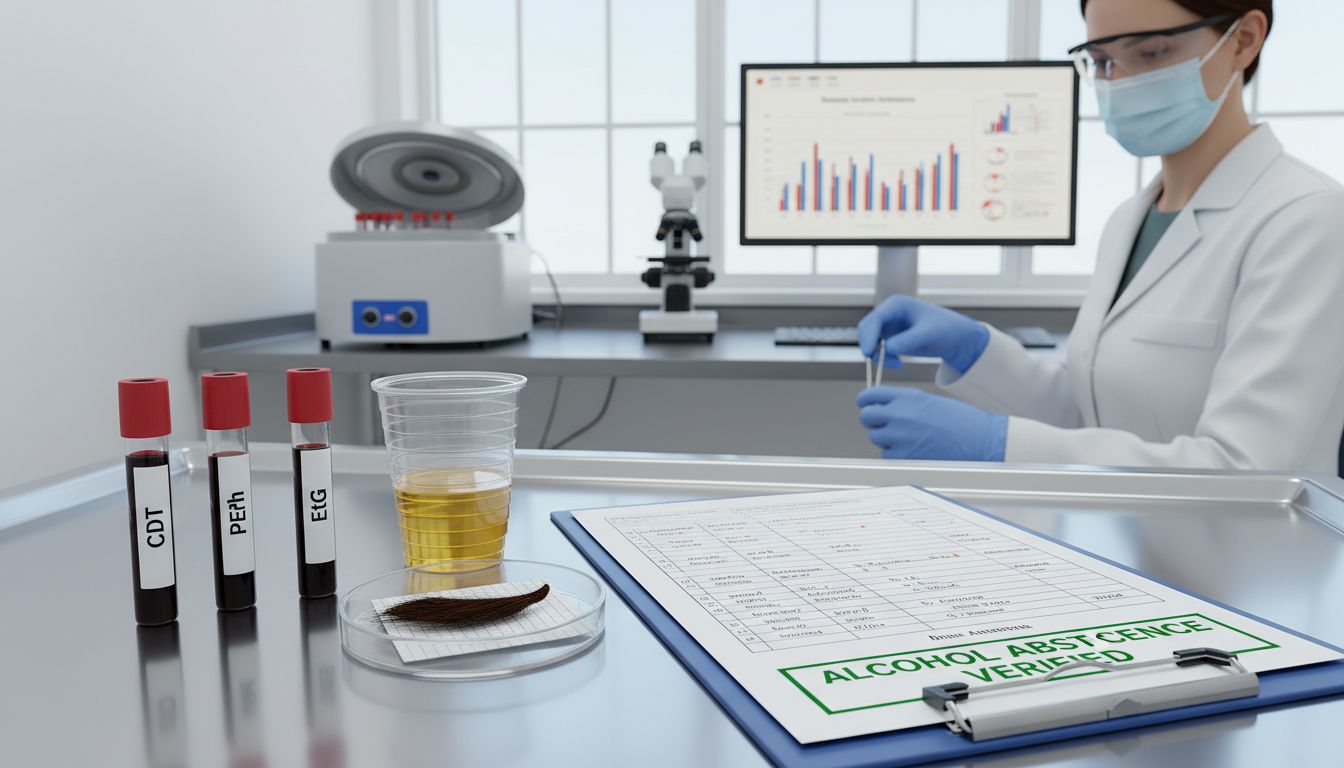
Genuine abstinence means that no alcohol has been consumed over an extended period. Breath or blood testing could only establish this through regular, uninterrupted checks. In everyday life, this is usually impractical. Assessment centres therefore use other approaches. Hair or urine samples are customary because they cover a longer window.
Direct contact: +49 171 4107688
Get your proof of abstinence here
By EMAIL: Kontakt@Abstinenznachweis.com
Hair analysis: how the sample is collected
Hair analysis detects not only drug residues but also alcohol breakdown products. Hair “stores” consumption so well that evidence can still be found months later.
For the examination, two bundles of hair are taken from the person being tested. Each is 3 centimetres long and approximately as thick as a pencil. They are usually taken from the back of the head. This is practical because scalp hair generally grows evenly. The time relationship is also important: one centimetre of hair corresponds to about one month. A 3 cm sample can therefore typically cover about three months.
Not everyone has enough scalp hair for hair analysis. In this case, a urine test is normally used instead. This is the usual alternative because it is standardised and can be organised quickly. Hair from other parts of the body is used less frequently.
Examples include pubic or underarm hair. This alternative is described as an exception rather than the standard approach. Ultimately, the assessment centre needs usable evidence. The method is therefore chosen to suit the person and situation. Those affected should clarify early on which type of sample is required.
Urine screening: procedure, supervision and detection window
Alcohol consumption can also be detected in urine. However, the detection period is much shorter than in hair. Appointments for urine screening are therefore generally arranged at very short notice. Screening is carried out by a qualified body appointed by the relevant authority.
The person attends the scheduled appointment and provides a sample. To prevent attempted fraud, the sample is provided under supervision in a designated cup. It is then analysed promptly.
The result can indicate whether alcohol was consumed during the previous 3–4 days. EtG is also described as detectable in urine for up to 72 hours, which explains why short-notice appointments are so important.
Detection periods at a glance: hours, days and months
Detectability depends strongly on the sample used. Breath and blood focus on the very short period around testing. Urine covers the previous few days. Hair can reach much further back because evidence of consumption “grows along” with it.
The important rule of thumb is: 1 cm of hair ≈ 1 month. A 3 cm hair sample therefore covers about three months. EtG is relevant to several sample types, but remains detectable for different lengths of time. In blood, EtG is detectable for only a few hours. In urine, it is detectable for up to 72 hours. In hair, depending on its length, EtG can still be detected months later.
| Method / sample | What does it detect? | Window stated in the text |
|---|---|---|
| Breath test | Consumption shortly before testing | Hours |
| Blood (general) | Consumption shortly before testing | Hours |
| Blood (EtG) | EtG as an alcohol marker | A few hours |
| Urine (urine screening) | Previous consumption | 3–4 days |
| Urine (EtG) | EtG as an alcohol marker | Up to 72 hours |
| Hair | EtG & FAEE from an earlier period | Months, depending on hair length |
EtG and FAEE: what is measured and what to consider before sampling
Previous alcohol consumption is assessed in hair using ethyl glucuronide (EtG) and fatty acid ethyl esters (FAEE). EtG forms even after consuming small amounts of alcohol. It is therefore considered a very reliable marker.
At the same time, the EtG level is described as potentially influenced by other factors. In urine, EtG is lower with increased fluid intake. In hair, haircare products, hair dye or tints can affect EtG levels. Intensive washing can also wash out some EtG. Nevertheless, according to the text, this cannot “manipulate” the result because the second marker, FAEE, cannot be altered.
People are therefore often warned in advance about foods and cosmetic products that may affect EtG and asked to avoid them. In certain cases, an assessment centre may even refuse hair analysis for this reason and require a urine sample instead.
| Influencing factor | Affected sample | Possible effect according to the text |
|---|---|---|
| High fluid intake | Urine (EtG) | The EtG level may be lower |
| Haircare products | Hair (EtG) | The EtG level may be affected |
| Hair dye / tint | Hair (EtG) | The EtG level may be affected |
| Intensive hair washing | Hair (EtG) | Some EtG may be “washed out” |
| FAEE | Hair | Described as unalterable, so “manipulation” is not possible |
The PEth blood test as a modern detection method
Anyone wondering how to prove alcohol abstinence should know about the PEth test. Phosphatidylethanol (PEth) is a direct alcohol marker that forms in the blood exclusively after alcohol consumption. Unlike conventional liver tests, PEth is highly specific and can reliably demonstrate moderate to heavy consumption over a period of up to three weeks.
This method is increasingly used in MPU practice as a supplement or alternative to hair analysis. It provides uninterrupted documentation because the marker is detected directly in the bloodstream. For those concerned, PEth testing offers a valuable way to substantiate their abstinence credibly and scientifically to the driving licence authority.
Proof of abstinence or controlled drinking?
A key planning question is which methods of proving alcohol abstinence are available and whether they are necessary in every case. In less serious cases, or following a first incident with a low blood alcohol level, “controlled drinking” may sometimes be sufficient as a strategy, with regular blood values (GGT, AST, ALT, CDT) documented.
However, where there is dependence or a very high blood alcohol level, a certified abstinence programme lasting 6, 12 or 15 months is essential. Evidence must then be provided through urine screening or hair analysis that meets the strict CTU criteria.
The right strategy should therefore always be agreed with an MPU adviser beforehand to avoid expensive mistakes.
The importance of CTU criteria and accreditation
To prove alcohol abstinence successfully, samples must be collected under forensically secure conditions. This is governed by the CTU criteria (chemical-toxicological examination), which have been tightened in the fourth edition of the assessment criteria.
Only laboratories accredited to DIN EN ISO/IEC 17025 may carry out these analyses for an MPU. The requirements include comprehensive identity verification and tamper-proof sample collection by trained staff.
Make sure your provider has these certifications, because the driving licence authority does not accept private rapid tests or reports from a GP that lack these special standards as official proof of abstinence.
Conclusion
Anyone who needs to prove alcohol abstinence should understand the reasoning behind the tests. Breath and blood cover only the previous few hours. For longer periods, hair analysis and urine screening are essential. With EtG and FAEE, hair can cover months, provided sufficient scalp hair is available. Urine covers a shorter period but is flexible. Follow guidance about cosmetics and foods so that your sample is accepted. This helps avoid unnecessary repeat tests and obtain recognised evidence. Appointments are arranged at short notice, and samples are provided under supervision at the assessment centre.
Sources:
- Bußgeldkatalog: Proving Alcohol Abstinence – Options & Costs
- ADAC: Proof of Abstinence for the MPU – How It Works
- TÜV SÜD: Official Information About Abstinence Programmes
FAQ
How long do I need to prove alcohol abstinence?
The duration depends on the issue being assessed in the MPU and is usually 6 or 12 months, or more recently up to 15 months. The more serious the offences or history, the longer the uninterrupted evidence period must be.
What methods are available to prove alcohol abstinence?
The most common methods are hair analysis for EtG and urine screening arranged at short notice under direct observation. The PEth blood test is also becoming more important for directly detecting consumption in blood over several weeks.
What is EtG and why is it important?
EtG stands for ethyl glucuronide and is a direct breakdown product of alcohol that remains detectable in the body much longer than ethanol itself. It is the standard marker in urine and hair analysis for reliably demonstrating even very small amounts of alcohol consumption.
Can my GP provide proof of abstinence?
An ordinary GP can only carry out these analyses if they have a qualification in traffic medicine and work with an accredited laboratory. In most cases, it is safer to visit an officially recognised assessment centre or a specialist laboratory.
How does urine screening work?
For urine screening, the person is called in unpredictably to provide a sample under direct observation within 24 hours. This procedure ensures that no alcohol has been consumed and that the sample has not been manipulated using someone else’s urine or dilution.
How far back can a hair analysis reach?
For proof of alcohol abstinence, hair analysis may examine at most the three centimetres of scalp hair closest to the scalp, corresponding to three months. Longer sections are usually not accepted for EtG evidence in an MPU because washing can remove substances from the hair.
How much does certified proof of abstinence cost?
Costs vary by provider and method. A single hair analysis usually costs between €150 and €250. A complete one-year urine programme can cost between €500 and €800 in total.
Are alcohol-free drinks allowed during abstinence?
Caution is required because many “alcohol-free” beers or juices may contain small residual amounts of ethanol that can lead to a positive EtG result. To avoid jeopardising proof of abstinence, strictly choose products labelled “0.0%” or avoid them entirely.
What happens if a test is positive?
A positive result generally leads to immediate termination of the abstinence programme and invalidates the evidence collected so far. In this case, the programme usually has to be started again from the beginning, costing time and money.
Why are liver tests alone no longer sufficient?
Conventional liver values such as GGT or AST are non-specific and can also be altered by illnesses or medicines without alcohol consumption. Current assessment criteria therefore require direct markers such as EtG or PEth for legally robust evidence.