
The liver is primarily responsible for breaking down THC (tetrahydrocannabinol), using cytochrome P450 enzymes, particularly CYP2C9 and CYP3A4, to convert it into metabolites such as 11-OH-THC and THC-COOH. This conversion plays a crucial role in determining how strong the effects are and how long they last.
It also explains why THC levels in blood fall quickly while tests can remain positive for a long time. THC is fat-soluble and is stored in the body. This combination of liver metabolism and fat storage makes its elimination complex.
Key points
- The liver primarily breaks down THC through CYP2C9 and CYP3A4, producing metabolites including 11-OH-THC and THC-COOH.
- 11-OH-THC can remain psychoactive even when the original THC level is already falling.
- THC is fat-soluble and accumulates in fatty tissue, extending the elimination period.
- The half-life is often described as around 1–2 days, but can vary considerably between individuals.
- Metabolites can remain detectable much longer than THC itself, sometimes for weeks.
How does the liver break down THC?
The liver mainly breaks down THC through cytochrome P450 enzymes, particularly CYP2C9 and CYP3A4, converting it into metabolites such as 11-OH-THC and THC-COOH, which are subsequently excreted in urine and faeces.
Why the liver is central to THC breakdown
The liver is the main organ involved in THC metabolism. The most important step takes place there: converting THC into breakdown products. This is primarily because the liver contains many enzymes that process foreign substances.
The liver therefore primarily breaks down THC (tetrahydrocannabinol) by converting it through cytochrome P450 enzymes. This process is predominantly hepatic, meaning it occurs directly in liver tissue.
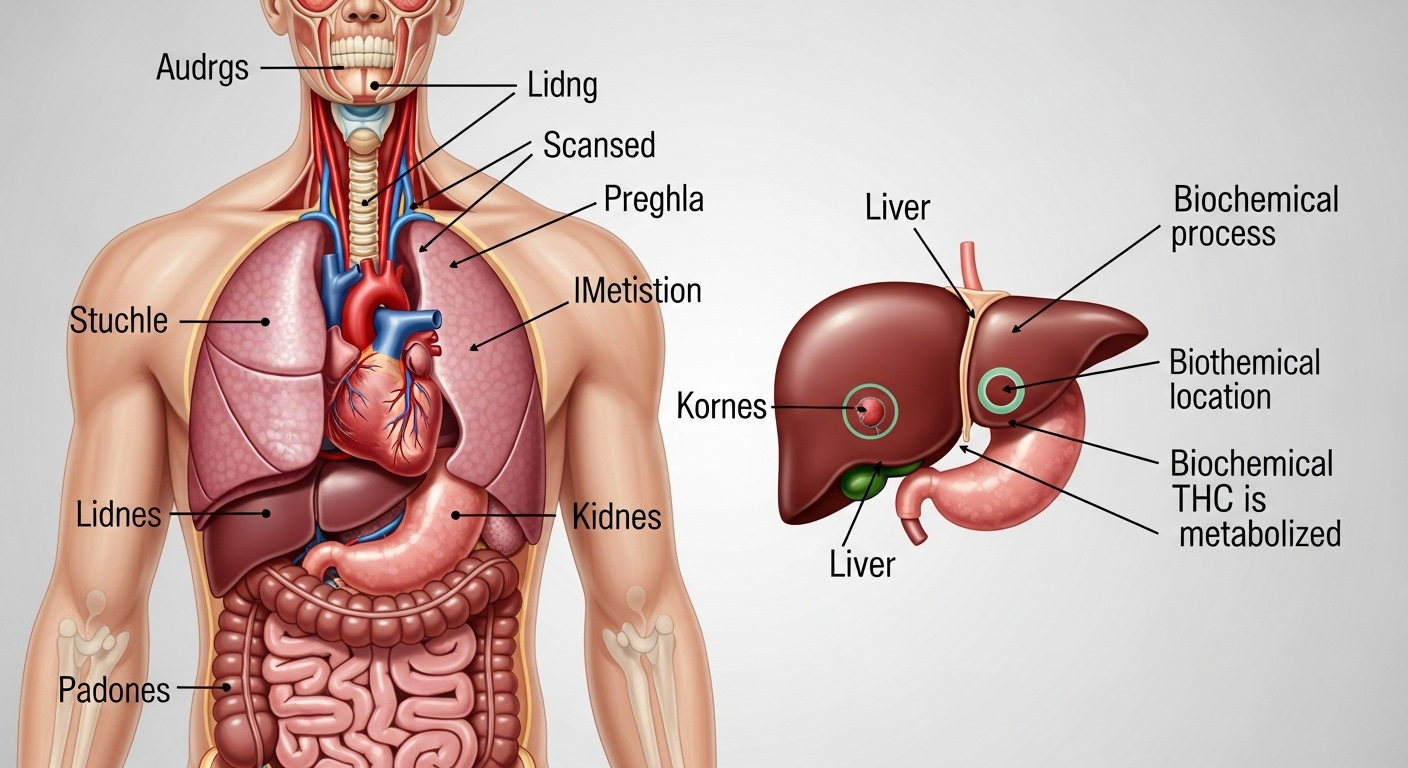
The resulting metabolites then enter the bloodstream. They are eventually processed further and excreted, leaving the body mainly through urine and faeces.
CYP2C9 and CYP3A4: the main enzymes in detail
Two enzymes are particularly important in THC breakdown: CYP2C9 and CYP3A4 from the cytochrome P450 family. They catalyse the conversion of THC into various metabolites.
This step helps determine how quickly THC disappears from the body. It also influences which intermediate products are formed, and these may continue to produce effects. Enzyme activity varies between individuals. Genetics, liver health and other factors can measurably alter the process, explaining why people do not experience the same consumption identically.
From THC to 11-OH-THC and THC-COOH: the metabolites formed
In the liver, THC is converted into substances including 11-OH-THC. This breakdown product is considered active and can retain psychoactive effects. This matters because falling THC levels do not automatically mean that effects are no longer possible. THC-COOH is often formed subsequently.
This product is particularly relevant to detectability because THC-COOH can be found in the body over a longer period. These metabolites are eventually prepared for excretion and leave the body mainly through urine and faeces.
Conversion and excretion
| Step | Main location | Important enzymes | Typical metabolites | Significance | Excretion |
|---|---|---|---|---|---|
| Metabolism | Liver (hepatic) | CYP2C9, CYP3A4 | 11-OH-THC, THC-COOH | Effects & detectability | Preparation for elimination |
| Elimination | Throughout the body after liver processing | – | Mainly metabolites | Leaving the system | Urine and faeces |
Routes of consumption and effects: smoking versus eating
THC enters the blood at different speeds depending on how it is consumed. Smoking usually causes blood levels to rise rapidly. With edible products, effects often begin later.
In both cases, however, THC enters the bloodstream and then reaches the liver, where conversion begins. Active metabolites may form there and continue to exert psychoactive effects. This explains why the perceived effects and measured values do not always match.
With oral consumption, the liver may also perform more extensive initial processing before THC reaches the rest of the body. These differences make comparisons difficult.
Fatty tissue as a store: why elimination takes longer
THC is fat-soluble, and this has consequences. It can accumulate in fatty tissue and remain there in a depot. THC is therefore not processed just once: it can gradually be released back into the blood.
This noticeably extends the overall elimination process. Half-lives of around 1–2 days are therefore frequently cited. In practice, however, this varies greatly between individuals. Body fat percentage matters because more storage tissue may be available. Consumption patterns are also crucial because stores are more likely to fill with frequent use.
Detectability: why tests remain positive for so long
THC itself often falls relatively quickly in blood, giving the impression that the substance has disappeared. In reality, metabolites remain detectable considerably longer. This particularly applies to THC-COOH, which can remain in the body for a long time.
The duration depends strongly on frequency of use. Body fat percentage also affects it because stored THC can continue to be released. Tests may therefore remain positive for weeks after the acute effects have ended. Different test types also measure different things, often breakdown products rather than active THC.
What typically remains, and for how long: general trends
| Sample | What tends to decrease quickly | What tends to remain longer | Why |
|---|---|---|---|
| Blood | THC | Some metabolites | THC falls rapidly while metabolites persist |
| Urine | – | Metabolites, e.g. THC-COOH | Excretion after liver metabolism, with long detection windows |
| Faeces | – | Metabolites | Excretion through the bowel after hepatic processing |
Enterohepatic circulation and detection time
When asking which organ breaks down THC, the liver takes centre stage, but enterohepatic circulation makes the process more complex than it may seem. Some THC metabolites formed in the liver are released into the intestine through bile.
From there, some return to the bloodstream and reach the liver again. This recycling effect keeps THC breakdown products in the body considerably longer than is the case with other substances.
This knowledge is crucial for proof of abstinence because it explains why urine tests may still be positive weeks after the last use, even though the primary organ responsible for breakdown has already worked intensively.
Liver biochemistry: the role of enzymes
The main answer to which organ breaks down THC is the liver, but the cytochrome P450 enzymes active there are decisive. CYP2C9 in particular plays a major role in converting psychoactive delta-9-THC into the also-active 11-hydroxy-THC (11-OH-THC), and ultimately into inactive THC carboxylic acid (THC-COOH).
The efficiency of these enzymes varies between people because of genetics, explaining individual differences in THC elimination. For well-informed MPU preparation, it helps to understand that home remedies cannot accelerate this enzymatic process, because liver enzyme capacity is biologically determined.
Lipophilicity: why organs temporarily store THC
Although the liver is the organ that breaks down THC, fatty tissue plays a crucial role as a temporary store. THC is lipophilic, meaning fat-soluble, so after consumption it rapidly moves from the blood into fatty organs and tissue structures.
From there, it is released back into the bloodstream very slowly, eventually to be metabolised in the liver. This delayed mechanism means THC metabolites can remain detectable in urine after a long period of abstinence, particularly when exercise or dieting mobilises fat reserves.
The interaction between fat storage and the liver is therefore the main reason for the unexpectedly long detection periods associated with cannabis.
Conclusion
The central point is clear: the liver primarily breaks down THC (tetrahydrocannabinol) through CYP2C9 and CYP3A4, producing metabolites such as 11-OH-THC and THC-COOH. These metabolites explain why effects may persist and tests often remain positive for a long time. Fat storage also prolongs the process. Understanding the liver, enzymes and storage depots helps explain what happens in your body and makes measurements and time frames easier to understand.
Sources:
- Cannabis Metabolism and Elimination: Pharmacokinetics
- Pharmacokinetic Calculations for Cannabis
- Cannabis Dependence – A Serious Condition
FAQ
Which organ primarily breaks down THC?
The main organ responsible for THC breakdown is the liver. There, enzymes convert psychoactive delta-9-THC into various metabolic products.
What role do the kidneys play in THC elimination?
The kidneys do not break down THC themselves, but are responsible for excreting water-soluble metabolites in urine. Around one third of the breakdown products leave the body this way.
How is THC converted in the liver?
In the liver, THC is first converted into active 11-hydroxy-THC and later into inactive THC carboxylic acid. The latter is the substance targeted by most drug tests.
Can you support the liver in breaking down THC?
There are no scientifically proven remedies or teas that significantly accelerate liver enzyme performance in THC breakdown. However, supporting healthy liver function through adequate fluid intake is generally beneficial.
Why does THC take longer to eliminate than alcohol?
THC is fat-soluble and accumulates in fatty tissue, from which it is released slowly. Alcohol, by contrast, is water-soluble and is broken down steadily and linearly by the liver.
What is enterohepatic circulation?
This is a process in which THC breakdown products return from the intestine to the liver instead of being excreted. This cycle significantly extends the time until the body is completely free of THC.
Does exercise influence the work of the organs involved in elimination?
Exercise stimulates metabolism, but fat breakdown can temporarily release more stored THC into the blood. This may temporarily increase the concentration of THC metabolites in urine.
Why are elimination times so long with chronic use?
With regular use, the body’s fat stores are saturated, so THC metabolites continually flow back into the blood and liver. The liver then needs considerably more time to process the accumulated burden.
Which enzymes are responsible for THC metabolism?
Cytochrome P450 enzymes, particularly CYP2C9 and CYP3A4, carry out the chemical conversion in the liver. Their activity is genetically influenced and differs between individuals.
Does THC disappear from the body immediately after breakdown?
No. After conversion in the liver, inactive metabolites must still be excreted through urine and faeces. Because this happens gradually, urine detectability often persists for a long time.