
Alcohol consumption becomes problematic when it no longer remains within medically acceptable limits or when the first consequences become visible in everyday life, health or behaviour. This is not just about the amount consumed.
Loss of control, recurring harm, strong cravings and continuing to drink despite negative consequences are also decisive. Even risky drinking levels can have serious long-term effects. This makes it all the more important to recognise warning signs early, understand the diagnostic criteria and seek help in good time.
Key points at a glance
- Problematic alcohol consumption often begins earlier than many people think: when health-related limits are regularly exceeded.
- More than 12 g of pure alcohol per day is considered risky for women, and more than 24 g per day for men.
- Harmful use occurs when alcohol repeatedly causes damage to health.
- Dependence becomes diagnostically relevant under ICD-10 when at least three typical features occur together within one year.
- Warning signs such as blackouts, drinking alone, morning drinking or social conflicts should always be taken seriously.
What is problematic alcohol consumption?
Alcohol consumption is problematic when alcohol is regularly consumed beyond health-related limits or when loss of control, health damage, symptoms of dependence and negative consequences in everyday life occur. What matters is therefore not only the quantity, but also the effect on the body, mind and social life.
When alcohol consumption is considered risky
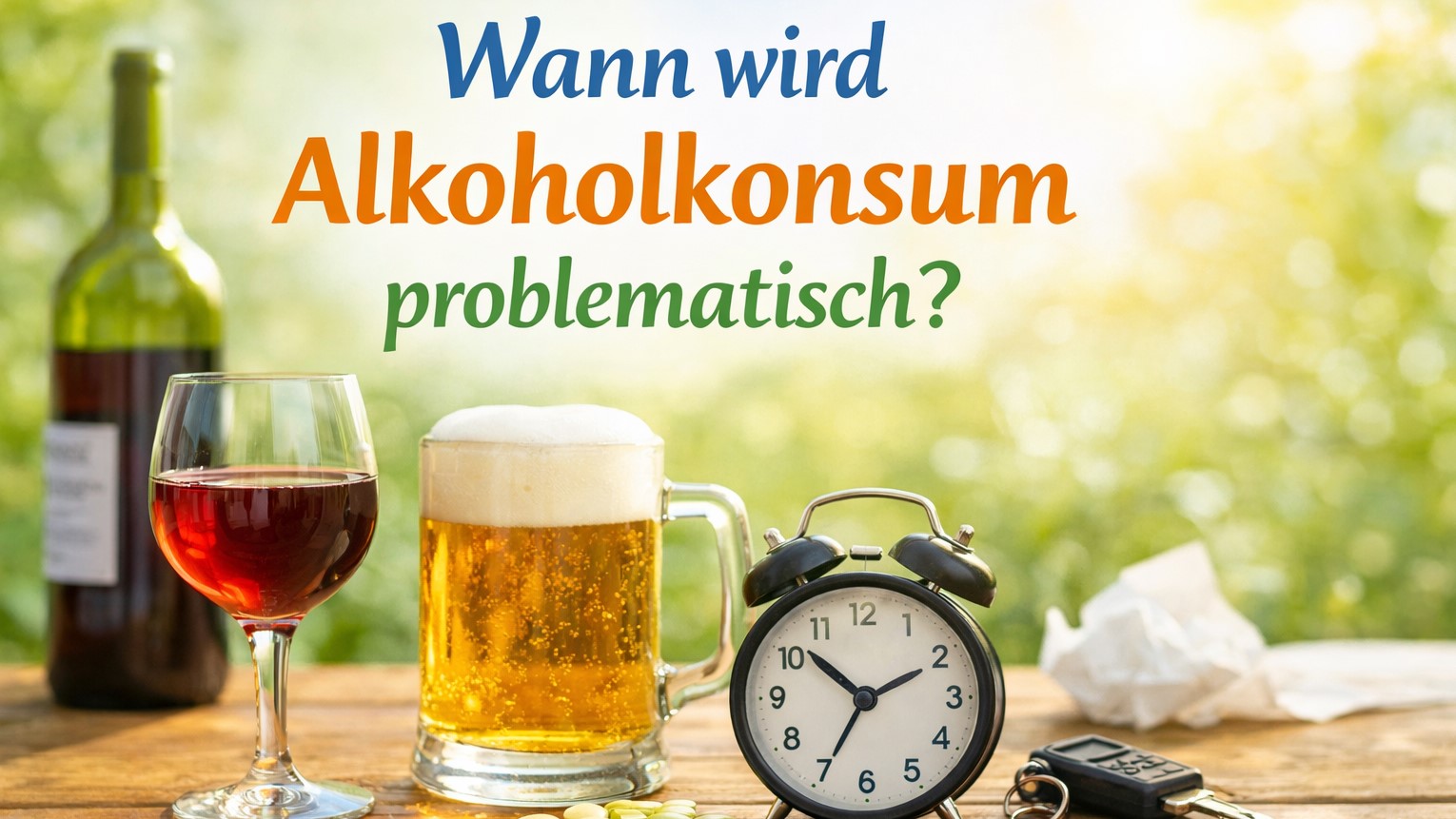
Not all alcohol consumption automatically means dependence. Nevertheless, there are clear health-related limits used to identify risky consumption. For women, more than 12 g of pure alcohol per day is considered risky.
This corresponds to approximately 0.25 litres of wine. For men, the threshold is more than 24 g per day, equivalent to around 0.5 litres of beer. Binge drinking is even more concerning. For women, more than 40 g of pure alcohol daily increases cancer and heart risks.
For men, more than 60 g is considered particularly dangerous. However, these figures are only a guide. During pregnancy, when taking medication or with pre-existing conditions, the health-related limit can be considerably lower.
| Group | Risky daily consumption | Example quantity | Particularly dangerous |
|---|---|---|---|
| Women | More than 12 g | Approx. 0.25 l wine | More than 40 g |
| Men | More than 24 g | Approx. 0.5 l beer | More than 60 g |
Why problematic consumption is not just about quantity
The amount consumed matters, but it does not tell the whole story. Problematic alcohol consumption often also becomes apparent in behaviour. Some people do not drink very large amounts every day but lose control in certain situations.
Others drink regularly despite already experiencing physical or psychological consequences. This is where the real problem begins. Alcohol is no longer used simply for enjoyment; it takes on a function in everyday life.
It may be used to calm down, manage stress or switch off. This can encourage the development of dependence. The consequences also often develop gradually. It is therefore important to look not only at the amount in the glass, but also at patterns, motives and consequences.
Recognising harmful use under ICD-10
A central diagnostic term is harmful use under ICD-10, coded F10.1. This applies when alcohol repeatedly causes harm to health. The harm must persist or recur over at least one month.
This does not refer only to physical consequences. Psychological impairment also counts. Examples include abnormal liver test results, depressive symptoms or other health problems triggered or worsened by drinking. The decisive factor is that clear harm has already occurred.
Dependence does not necessarily have to be present. This is precisely why the issue matters. Recognising harmful use early often makes it possible to take corrective action before established dependence develops.
| Diagnosis | ICD-10 code | Characteristics |
|---|---|---|
| Harmful use | F10.1 | Repeated harm to health over at least one month |
| Alcohol dependence | F10.2 | At least three features of dependence within one year |
How alcohol dependence becomes apparent
Alcohol dependence under ICD-10, coded F10.2, is identified when at least three typical features occur together within one year. A particularly important sign is a strong desire for alcohol, also called craving. Loss of control over the amount and duration of drinking is also typical.
Many people also report withdrawal symptoms such as shaking or sweating when they do not drink. Another criterion is increased tolerance, meaning that more and more alcohol is needed to achieve the same effect.
Neglecting other interests is also a clear warning sign. Hobbies, social contacts or work responsibilities take a back seat. The situation becomes especially clear when drinking continues despite known harm. This combination shows that alcohol consumption is no longer freely controlled.
| Features of dependence under ICD-10 | Description |
|---|---|
| Strong desire | An intense wish or compulsion to drink |
| Loss of control | The amount or duration of consumption can no longer be reliably controlled |
| Withdrawal symptoms | For example, shaking, sweating or internal restlessness |
| Increased tolerance | More alcohol is needed for the same effect |
| Neglect of other interests | Everyday activities, hobbies and social relationships lose importance |
| Drinking despite harm | Consumption continues despite known consequences |
Warning signs that should be taken seriously
Problematic alcohol consumption often becomes visible early in everyday life. Social problems are a common first sign. Arguments in a relationship, conflicts among friends or difficulties at work should therefore prompt attention.
Blackouts are another clear warning sign. If you cannot remember certain periods after drinking, do not minimise it. The same applies to morning drinking. Needing alcohol to start the day or relieve symptoms is particularly serious. Drinking alone may also indicate that consumption patterns have changed.
The problem affects many people in Germany. According to the figures cited, approximately 2.2 million people live with dependence, while around 9.5 million have risky alcohol consumption. This clearly shows how widespread the issue is and how important early recognition remains.
Practical steps people can take now
The most important step is to examine your own drinking honestly. A self-test, such as the AUDIT questionnaire, can be a useful starting point. Such tests are available online from organisations including DAK or Krebsinfo.
They do not replace a diagnosis but provide an initial assessment. Anyone recognising warning signs should not hesitate to seek help. Anonymous counselling can provide an accessible and reassuring first point of contact.
The alcohol hotline cited here is 0800 111 0333. Addiction counselling services or your GP practice are other options. It is important to use support early. The sooner problematic consumption is recognised, the better the chances of limiting its health and social consequences.
Quantitative limits and the standard-drink model
To assess objectively when alcohol consumption becomes problematic, understanding the medical limits is essential. Germany’s Federal Centre for Health Education (BZgA) defines a “standard drink” as approximately 10–12 grams of pure alcohol, equivalent to a small beer of 0.3 l or a glass of wine of 0.125 l.
For healthy women, no more than one standard drink per day is considered low-risk, and for men no more than two, but on no more than five days per week. Regularly exceeding these amounts already places consumption in the risky category.
These clear figures help people assess their own drinking beyond subjective impressions and take action before physical harm occurs.
Psychological warning signs and secret drinking
The answer to when alcohol consumption becomes problematic often begins with behaviour rather than laboratory findings. One critical warning sign is “relief drinking”, where alcohol is deliberately used to cope with stress, anxiety or sleep problems.
Starting to hide the actual amount consumed from relatives or building up supplies usually means that the boundary into problematic drinking has already been crossed. Gradually increasing tolerance, where ever larger quantities are needed for the same effect, is another indication of emerging dependence.
Anyone noticing that their thoughts increasingly revolve around the evening drink during the day should treat this as a serious psychological warning sign and seek professional advice.
The clinical criteria for dependence under ICD-10
In medicine, the question of when alcohol consumption becomes problematic is answered using ICD-10 criteria. Dependence is present when at least three of the following six features occurred together within the previous year: a strong desire or craving; reduced ability to control consumption; physical withdrawal symptoms on stopping; tolerance to alcohol’s effects;
neglect of other interests in favour of drinking; and continued consumption despite demonstrably harmful consequences. These criteria make clear that addiction is not a moral failure but a chronic illness.
Understanding these features is crucial when starting treatment or preparing to obtain proof of abstinence, because they reflect the biological and psychological depth of the problem.
Conclusion
Problematic alcohol consumption does not begin only with severe dependence. Regular drinking above health-related limits, initial losses of control or recurring negative consequences are already clear warning signs. Recognising these signals allows earlier action and targeted help. This is crucial to avoiding physical, psychological and social harm. If you want to know whether your consumption remains within limits or is already risky, examining the criteria described here is worthwhile.
Sources:
- Alcohol Guidelines: “ICD-10 Criteria”
- Stiftung Gesundheitswissen: “Alcohol: When Do Drinking Habits Become Problematic?”
- Robert Koch Institute: “Journal of Health Monitoring | 3/2025 | Alcohol Consumption”
FAQ
How many grams of alcohol per day become dangerous?
For women, the low-risk consumption limit is approximately 12 grams of pure alcohol daily, equivalent to a small glass of wine. Men should consume no more than 24 grams of pure alcohol to avoid long-term harm to health.
What is a “standard drink”?
A standard drink is a unit containing approximately 10 to 12 grams of pure alcohol, regardless of the type of beverage. Examples include 0.3 litres of beer, 0.125 litres of wine or a double measure of spirits of 4 cl.
Why are two alcohol-free days per week so important?
These days allow the liver to recover physically and prevent psychological habituation. Alcohol-free days are the most effective way to prevent gradually increasing tolerance and dependence.
What is the difference between misuse and dependence?
Alcohol misuse describes consumption that already causes physical, psychological or social harm without necessarily involving addiction. Dependence is characterised by an internal compulsion, loss of control and often physical withdrawal symptoms.
Can an “occasional drinker” also have a problem?
Yes. Binge drinking, where large amounts are consumed in a short time, is highly problematic. The main concerns are acute toxic effects and accident risk rather than the daily quantity.
How can I recognise an emerging alcohol problem in myself?
Needing alcohol to cope with negative feelings or stress is a clear warning sign. Hiding the amount consumed from people around you also indicates problematic consumption.
What role does genetics play in alcoholism?
Studies show that a tendency towards problematic alcohol consumption can be partly inherited and that family history increases the risk. However, environmental factors and individual stress management play equally important roles in its development.
What happens in the body during “relief drinking”?
Drinking to relax briefly activates the brain’s reward system but reduces natural stress resilience over time. The body loses the ability to cope with negative emotions or tension without alcohol’s help.
When is official proof of abstinence required?
Proof of abstinence is usually required when fitness to drive must be assessed through an MPU after drink-driving. Urine or hair analysis may also be necessary in certain child custody disputes or for occupational requirements.
Can a damaged liver recover after stopping alcohol?
The liver has a strong capacity to regenerate and can often recover fully from fatty liver if alcohol is consistently avoided. However, if cirrhosis is already present, the tissue damage is irreversible and permanent abstinence is vital.