
A drinking unit, referred to here by the German abbreviation TE, is a simple but very practical measure. In Germany, it is used as a standard for controlled drinking. One TE corresponds to 10 grams of pure alcohol. This is particularly helpful when you want to manage consumption transparently, for example during MPU preparation.
To compare drinks accurately, you need only one formula and a few guide values. This article explains the relevant information concisely and provides specific examples for beer, wine and spirits, helping you understand more quickly what you are actually drinking.
Key points at a glance
- 1 drinking unit (TE) = 10 g of pure alcohol, a common standard measure for controlled drinking in Germany, for example in MPU preparation.
- Pure alcohol can be calculated as: volume (ml) × ABV (%) / 100 × 0.8 = grams of alcohol.
- Examples help with quick assessment: 250 ml beer at 5% ≈ 10 g; 125 ml wine at 12% ≈ 12 g; 20 ml spirits at 40% ≈ 6.4 g.
- Daily limits: men maximum 24 g (2.4 TE), women maximum 12 g (1.2 TE).
- Anyone wanting verifiable control should not exceed these limits and should document consumption consistently.
What is a drinking unit (TE), and how much alcohol does it contain?
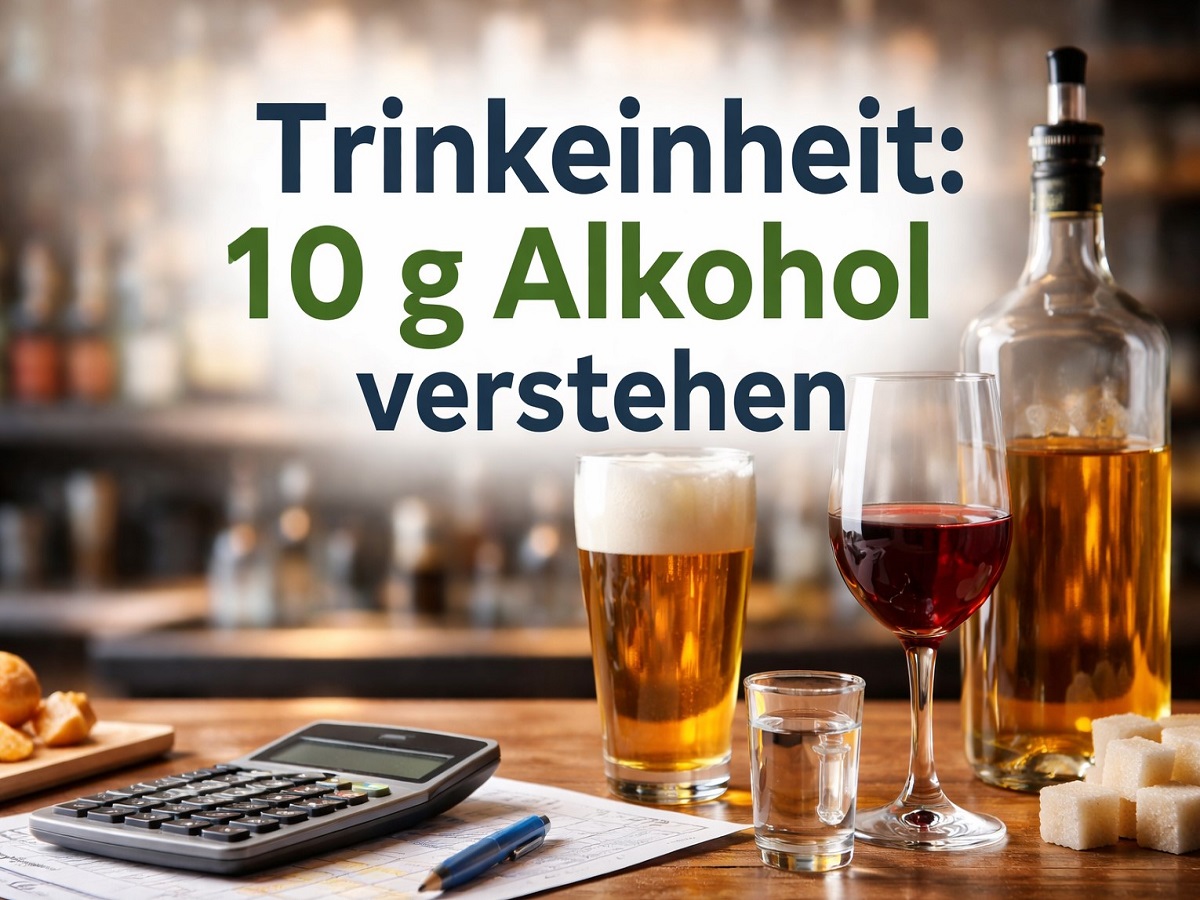
A drinking unit, TE, is a standard measure for controlled drinking in Germany and corresponds to 10 grams of pure alcohol.
What exactly does “drinking unit (TE)” mean?
A drinking unit is a comparison measure for alcohol. It describes not the size of the glass but the amount of pure alcohol it contains. The key point is that 1 TE equals 10 grams of pure alcohol. This makes different drinks easier to compare.
Beer, wine and spirits vary greatly in volume and alcohol percentage. TE allows clearer planning of consumption, particularly when you want to drink consciously and in a controlled way. This standardisation is frequently used in Germany, including in MPU preparation.
Why is 10 grams of alcohol the standard in Germany?
The 10-gram approach is primarily practical. It provides a shared language for control and documentation. “Two drinking units” is easier to assess than “a large beer and a glass of wine”. This matters because serving sizes vary considerably. Restaurants pour differently from people at home. TE makes the amount of pure alcohol tangible.
In controlled drinking, the important factor is the alcohol quantity, not the beverage. TE is therefore a widely used standard measure in Germany, including for MPU preparation. It makes planning clearer and reduces misunderstandings.
How to calculate grams of pure alcohol correctly
To determine drinking units accurately, first calculate the number of grams. Use this formula: volume (ml) × ABV (%) / 100 × 0.8 = grams of alcohol. The volume in millilitres is the amount actually in the glass. The alcohol percentage appears on the bottle or menu. Dividing by 100 converts the percentage.
The factor 0.8 converts alcohol volume into mass, giving grams of pure alcohol. You can then compare the result with the TE value and immediately see whether a drink contains approximately 1 TE or significantly more.
Examples: beer, wine and spirits
Examples make everyday calculations quicker. They immediately show that “one drink” does not automatically mean “one TE”. A small beer may be approximately one TE. A glass of wine is often slightly above that. A small spirit measure may be considerably below it despite seeming strong.
Volume and alcohol percentage are always decisive. Use the examples as a guide, but recalculate for different serving sizes. Larger glasses and mixed drinks can quickly alter the values. This table summarises typical examples:
| Drink | Volume | ABV (%) | Grams of alcohol |
|---|---|---|---|
| Beer, pilsner | 250 ml | 5 | 10 g |
| Wine | 125 ml | 12 | 12 g |
| Spirits/liqueur | 20 ml | 40 | 6.4 g |
Daily limits: what men and women should consider
Clear limits are central to controlled drinking. Daily guide values are a maximum of 24 g for men and 12 g for women. This corresponds to 2.4 TE and 1.2 TE respectively. These values are deliberately low because exceeding them makes adherence harder to demonstrate.
Anyone documenting control should not exceed these limits, especially when reliability and verifiability matter. The limit concerns grams of alcohol, not the number of glasses. This is why TE and the formula are so useful: they prevent misleading impressions about quantities.
Practical application: controlled drinking that remains verifiable
Controlled drinking works best with a routine. First check the glass size and alcohol percentage. Then calculate grams using volume (ml) × ABV (%) / 100 × 0.8. Convert the result into drinking units.
This shows whether you are close to 10 g or above it. Plan your day around the limits of 24 g for men and 12 g for women. Stay below them when verifiability matters. Record drinks and quantities directly, ideally immediately, to reduce errors and make consumption transparent.
The mathematical formula for your own calculations
Estimating is often insufficient for precise calculation of drinking units. The exact formula is volume (ml) × (ABV (%) / 100) × 0.8 = grams of pure alcohol. When calculating alcohol in beer, wine and spirits, the factor 0.8 matters because alcohol is less dense than water.
In Germany, one TE is usually equated with 10 to 12 grams of pure alcohol. This formula allows accurate calculations even for unusual glass sizes or mixed drinks, so you can determine whether you remain within your planned consumption limits.
It provides confidence for MPU preparation and demonstrates to the assessor that you have examined the topic mathematically.
Variation in alcohol content in wine and strong beer
People often use average values, but anyone taking drinking-unit calculations seriously must read the label. A light pilsner at 4.8% differs significantly from strong beer at 8% or more.
Wine varies particularly widely: a 0.2 l glass of light white wine at 11% contains approximately 17.6 g of alcohol, while a strong red at 14.5% contains 23.2 g, almost half a drinking unit more. The specific alcohol percentage is the most important variable when calculating precisely how many grams are in beer, wine and spirits.
This accuracy is essential to avoid unknowingly exceeding the strict 0.3-per-mille blood alcohol limit per occasion.
Using the calculation in your MPU drinking diary
Correct calculation of drinking units is the foundation of your drinking diary. An MPU assessor expects not just a list of occasions but detailed quantities in grams for each event.
By explicitly recording how many grams of alcohol were in the beer, wine or spirits you consumed, you demonstrate knowledge and self-control. One TE corresponds approximately to a small glass of beer, 0.25 l, or a small glass of wine, 0.1 l.
Continuous documentation of these units for at least six months demonstrates that you do not merely plan to separate drinking and driving, but implement that separation with mathematical control and reflection.
Conclusion
Drinking units make alcohol comparable: 1 TE equals 10 grams of pure alcohol. The formula volume (ml) × ABV (%) / 100 × 0.8 calculates each drink accurately. The examples show how greatly serving sizes and percentages differ. Observe the daily limits of 24 g for men and 12 g for women. This keeps consumption planned and verifiable. Save the formula and check your usual glasses to reduce uncertainty later.
Sources:
- Alcohol – Low-Risk and Dangerous Consumption
- Frequently Asked Questions About Alcohol
- Calculating Alcohol Quantities – BKK24
FAQ
How many grams of alcohol equal one drinking unit?
In Germany, one TE is usually defined as approximately 10 to 12 grams of pure alcohol. This corresponds to a small glass of beer, 0.25 l, or a glass of sparkling wine, 0.1 l.
How do you calculate the grams of alcohol in a drink?
Multiply the volume in millilitres by the alcohol percentage and the factor 0.8, then divide by 100. The result gives the exact amount of pure alcohol in grams.
Why is the factor 0.8 important?
Alcohol is less dense than water, at approximately 0.8 grams per cubic centimetre. Without this correction factor, the amount actually consumed would be overestimated.
How many grams of alcohol are in a 0.5 l beer?
A standard beer at 5% ABV contains exactly 20 grams of pure alcohol in 500 ml. Under the common definition, this corresponds to approximately two full drinking units.
How many grams of alcohol are in a 0.2 l glass of wine?
A 0.2 l glass of wine at 12% ABV contains exactly 19.2 grams of pure alcohol. With stronger wine at 14%, this rises to more than 22 grams.
What is a standard drink in controlled drinking?
A standard drink is a reference measure for comparing different alcoholic beverages. Each standard serving, such as 0.1 l of wine or 0.33 l of beer, contains approximately the same number of grams of alcohol.
How many drinking units are allowed per occasion?
In MPU preparation, an occasion should usually involve no more than two drinking units. The aim is to remain below the critical blood alcohol concentration of 0.3 per mille.
Why must spirits be calculated particularly carefully?
Spirits have a very high alcohol content, usually 40% ABV, so even tiny quantities contain many grams. A double shot of 4 cl already contains approximately 12.8 grams of pure alcohol.
Does calculating grams help estimate blood alcohol concentration?
Yes. The calculated grams form the basis of the Widmark formula for estimating blood alcohol concentration. Body weight and sex are then considered to estimate the expected per-mille value.
Why do MPU assessors require quantities in drinking units?
Using drinking units shows the assessor that you have examined your consumption in depth. It demonstrates cognitive control that goes beyond a mere “feeling” while drinking.