
Diagnosing alcohol dependence under ICD-10 follows defined medical standards. It is based on six criteria covering physical, psychological and social aspects. When at least three features have occurred together within twelve months, diagnosis F10.2 is assigned. The process helps assess the condition and select suitable treatment. Thorough assessment provides a foundation for recovery and long-term stability.
Key points at a glance
- ICD-10 defines six criteria, at least three of which must be met.
- They cover behaviour, physical symptoms and psychological changes.
- F10.2 applies when the required criteria occur together within twelve months.
- Treatment includes withdrawal management, psychotherapy, social support and medication.
- A comprehensive combination of treatments improves the prospects of long-term recovery.
When is alcohol dependence diagnosed under ICD-10?
Alcohol dependence is diagnosed when at least three of six defined criteria, such as impaired control, withdrawal symptoms or tolerance, have occurred together within the preceding twelve months.
The importance of the ICD-10 criteria
ICD-10 provides an internationally recognised framework for diagnosing alcohol dependence. Clear guidelines help doctors identify dependence reliably and reduce misinterpretation. The criteria address physical and psychological features alongside changes in social functioning. This supports a comprehensive assessment and recognises dependence as a medical condition, helping people access professional support.
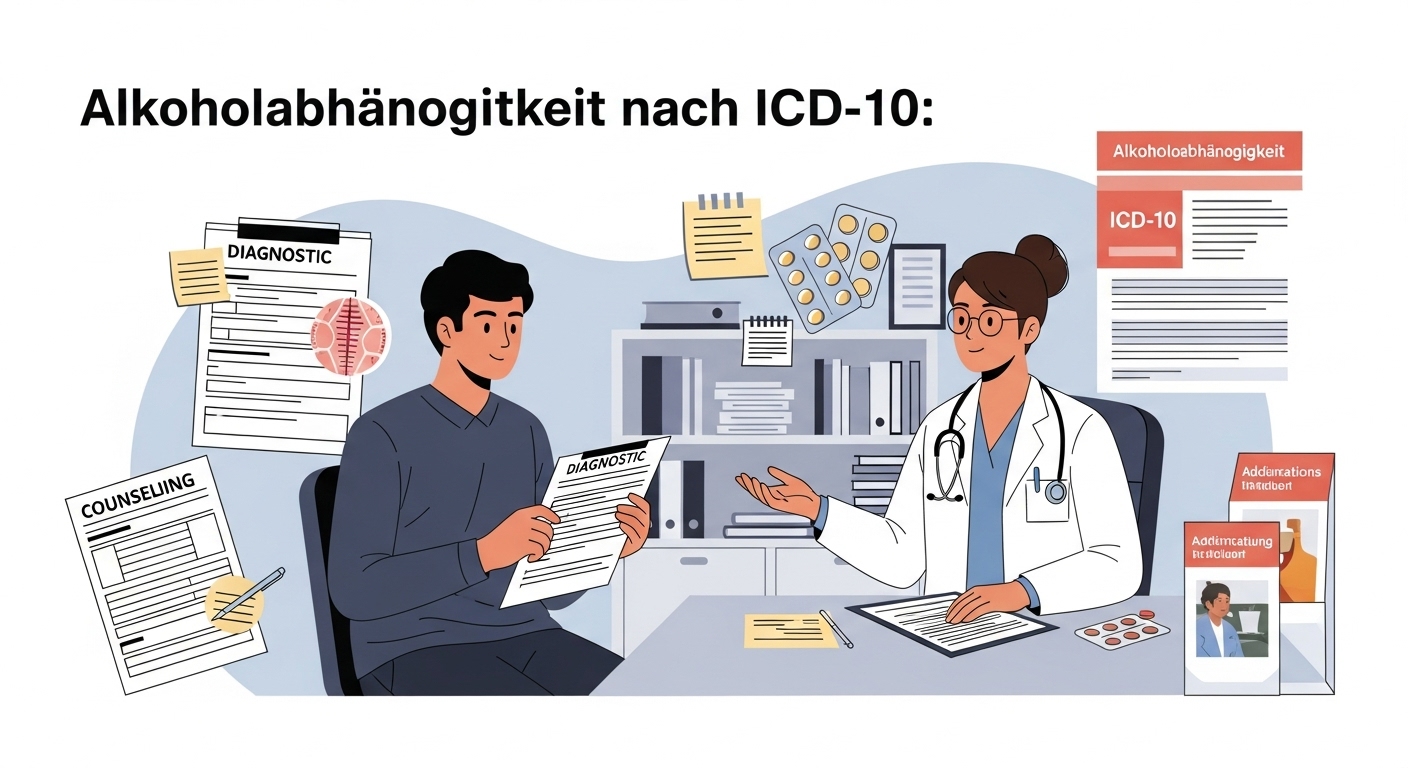
Overview of the six diagnostic criteria
The criteria describe both behaviour and physical reactions. A strong urge to drink is a central feature. Others include loss of control over the duration and amount of drinking, withdrawal after reducing consumption, and increasing tolerance. Neglect of other interests and continued drinking despite harm complete the set. Together they show the wide-ranging effects of the condition.
ICD-10 criteria for alcohol dependence
| Criterion | Description |
|---|---|
| Strong desire | An urge or compulsion to drink alcohol |
| Impaired control | Difficulty controlling the start, end or amount of consumption |
| Withdrawal | Physical symptoms when reducing or stopping alcohol |
| Tolerance | Increasing amounts needed for the same effect |
| Neglect of interests | Reduced attention to hobbies, work and social contacts |
| Continued use | Drinking despite health or social harm |
Time frame and diagnostic requirements
The time frame matters as well as the presence of symptoms. At least three features must have occurred together within the preceding twelve months. This supports a reliable assessment rather than interpreting a brief difficult period in isolation. Doctors can evaluate the pattern and select appropriate treatment steps using a consistent framework.
Treatment approaches and their roles
Treatment has several components. Withdrawal management often comes first to stabilise the body and medically relieve symptoms. Psychological treatment then helps identify triggers and change behavioural patterns. Psychosocial support, including peer-support groups, complements care. Medication may help prevent relapse. Combining approaches addresses the condition beyond its physical aspects.
Co-occurring physical and mental health conditions
Many people also experience depression, anxiety disorders or organ damage, which can complicate treatment. A comprehensive assessment identifies all relevant health factors. Multidisciplinary care involves doctors, psychologists and social-care professionals working together to address the different influences.
Why combined treatment is effective
Alcohol dependence affects several areas of life, so one treatment alone is rarely sufficient. Medical care, psychotherapy and social support work together to improve stability and prevent relapse. Progress can strengthen motivation, while different approaches address different triggers. Comprehensive care offers a stronger foundation for lasting abstinence.
The complete list of six criteria
Alcohol dependence under ICD-10 (F10.2) is diagnosed when at least three of the following have occurred together during the preceding year: 1) strong desire or craving; 2) impaired control over the start, amount or end of drinking; 3) physical withdrawal; 4) tolerance; 5) progressive neglect of other interests in favour of alcohol; and 6) continued use despite clear harm. Accurate diagnosis and treatment depend on careful assessment of these core features.
Distinguishing subtypes: F10.20 to F10.26
Additional digits can specify the current state. The German original gives examples labelled F10.20 for current drinking, F10.21 for abstinence during treatment and F10.24 for sustained full remission. It highlights the importance of recording a stable longer-term state when evidence of abstinence is relevant to an MPU. These subtype descriptions require checking against the applicable national ICD version.
Transition to ICD-11
The World Health Organization introduced ICD-11 as the successor to ICD-10. Alcohol dependence, F10.2 under ICD-10, appears as 6C40.2 under ICD-11. Some diagnostic features are grouped differently.
This supports a more contemporary international classification. The original describes ICD-10 as remaining the primary framework in Germany while medical standards continue to develop.
Conclusion
ICD-10 provides a structured basis for recognising alcohol dependence and choosing treatment. Combining withdrawal care, psychotherapy and social support addresses the condition comprehensively. Understanding the criteria can encourage earlier action and improve the opportunity for sustained recovery.
Sources:
- gesund.bund.de: ICD-10 code F10.2, dependence syndrome (German)
- My Way Betty Ford Clinic: alcohol dependence under ICD-10 (German)
- Alkoholleitlinie.de: ICD-10 criteria (German)
FAQ
What is the ICD-10 code for alcohol dependence?
The code is F10.2, describing dependence syndrome. Clinicians use it to record the diagnosis and guide treatment.
How many criteria must be met?
At least three of the six defined features must have occurred together during the preceding year. They include impaired control and craving.
What does craving mean?
Craving is a strong, sometimes overwhelming desire or compulsion to drink. It is an important psychological feature of dependence.
Can F10.2 be diagnosed in someone who drinks only occasionally?
Diagnosis depends on the overall pattern and whether the required criteria are met. Frequency alone does not establish or rule out dependence. Harmful use without dependence is classified separately under F10.1.
What role does tolerance play?
Tolerance means needing increasing amounts to obtain a previously experienced effect. It is one of the six diagnostic features.
What is the difference between F10.1 and F10.2?
F10.1 describes harmful use that has damaged health, while F10.2 describes dependence syndrome meeting the required criteria.
What does F10.24 mean?
The German original describes it as sustained full remission after at least twelve months of abstinence and links this to MPU evidence. Subcode meanings vary with the national classification and should be checked against the version used by the treating clinician.
What are typical withdrawal symptoms?
Shaking, sweating, a racing heart and restlessness may occur when alcohol is reduced or stopped. Withdrawal is one diagnostic feature and may require medical supervision.
Which treatments are used?
Treatment commonly begins with medically supported withdrawal and continues with inpatient or outpatient rehabilitation. Psychotherapy and behavioural treatment are central components.
Is the diagnosis relevant to the MPU?
A dependence diagnosis can be relevant when the driving-licence authority requires evidence of abstinence. Assessment considers insight, treatment and lasting change.
