
After a drink-driving incident, many people want to drink “consciously and safely” rather than “never again”. This is where controlled drinking comes in. However, it is not a solution for everyone. It is suitable only when there is no severe alcohol dependence and you have developed genuine awareness of the problem.
You must also be able to manage your consumption reliably and demonstrate this. In the MPU context, clear criteria therefore matter, including blood alcohol concentration, previous history, health and supporting evidence. This article explains when controlled drinking is realistic and when abstinence remains the better route.
Key points at a glance
- Controlled drinking is suitable only for people without severe alcohol dependence who have recognised their problem.
- You must show that you can demonstrably manage consumption, not merely express good intentions.
- Typical suitable cases involve lower blood alcohol concentrations at the offence, usually below 2.0‰, rarely up to 2.5‰ with a very convincing explanation and evidence.
- No repeat offences and a moderate drinking history without chronic misuse are major positive factors.
- Evidence such as urine/hair analyses, for example EtG < 100 ng/ml, and a specific documented drinking plan are often decisive.
Who is suitable for controlled drinking in the MPU?
Controlled drinking is primarily suitable for people without severe alcohol dependence who demonstrate clear problem awareness and can credibly limit consumption. Typical features include lower blood alcohol concentrations at the offence, no repeat offences and a moderate drinking history without chronic misuse. The crucial point is that you follow rules and can demonstrate this through evidence and documentation.

Who genuinely benefits from controlled drinking?
Controlled drinking suits people who are not severely dependent. It requires honest awareness of the problem. You should be able to identify clearly what went wrong and show how you will prevent it in future.
It is also important that you can actively manage consumption. This means making decisions beforehand and following them. Wanting to “see how things go” spontaneously quickly appears uncertain. In the MPU, what matters is verifiable implementation, not intention.
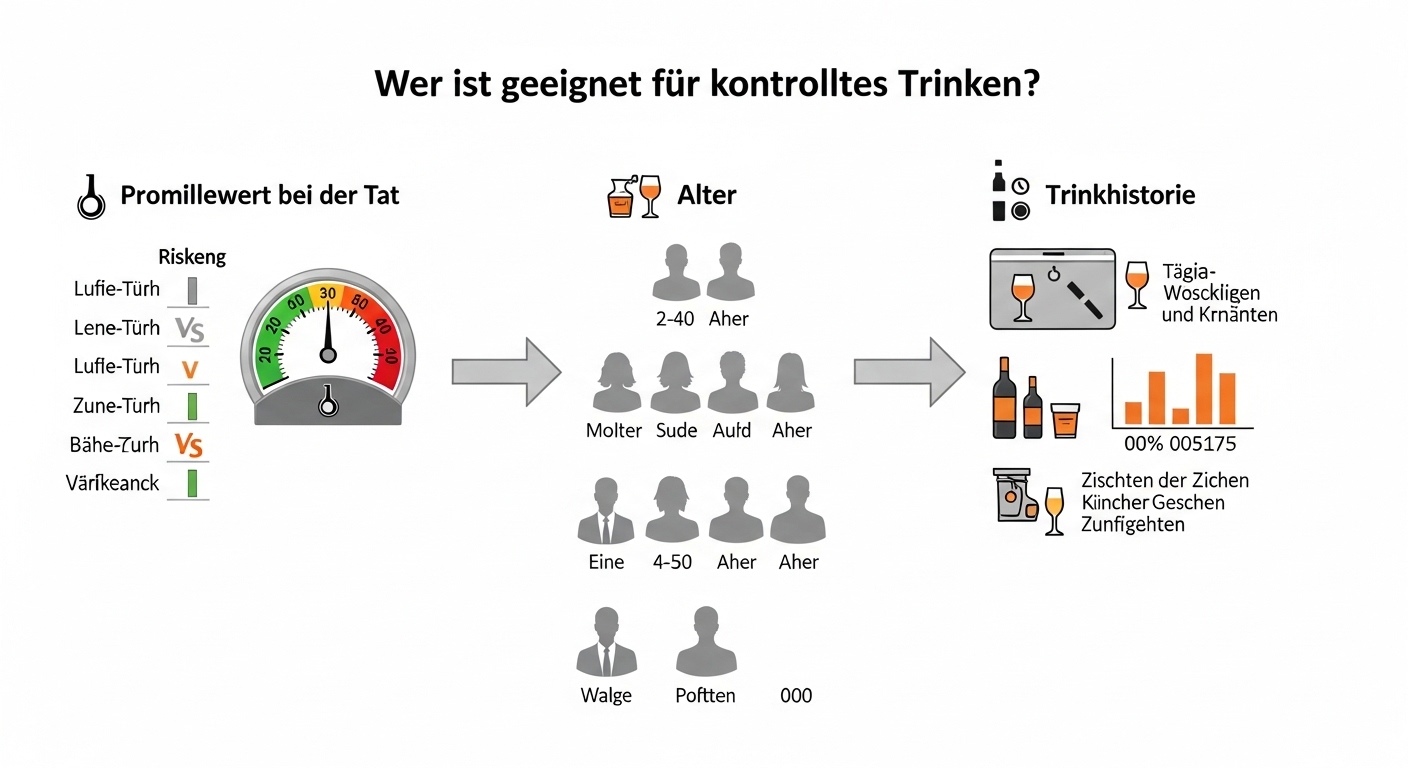
Blood alcohol concentration and the circumstances of the offence
The blood alcohol concentration at the offence is a strong signal in the assessment. Often, below 2.0‰ is considered more compatible with controlled drinking. In individual cases, it may also work up to 2.5‰, but particularly convincing evidence and a good explanation are then needed.
Values above 2.5‰ are often a clear warning sign, especially if there were accident consequences. The circumstances matter too: was it an isolated incident or part of a pattern? Assessors examine whether you can now judge the situation better and whether you have derived stable rules from it.
Important criteria at a glance
| Criterion | Suitable | Not suitable |
|---|---|---|
| Blood alcohol concentration | < 2.0‰, rarely up to 2.5‰ with evidence | > 2.5‰ or accident consequences |
| Drinking history | Occasionally high but controllable, e.g. fewer than 12 standard drinks per week | Daily consumption and dependence symptoms |
| Age | Younger, under 40, with high potential for change | Older with entrenched habits |
| Other factors | Normal liver values and urine/hair evidence | Repeat offending and liver damage |
Drinking history: moderate rather than chronic
Your drinking history shows whether consumption was situational or persistently problematic. Controlled drinking appears more suitable if you do not drink daily, even if there were periods of excessive drinking.
What matters is whether it was controllable and is now clearly limited. A moderate amount such as fewer than 12 standard drinks per week may be cited as a rough guide. However, the pattern matters as much as the quantity.
Was there loss of control, morning drinking or withdrawal? Such dependence symptoms clearly argue against controlled drinking. Abstinence is then usually the more coherent and credible route.
Assessing age and capacity for change realistically
Age can also play a role in the MPU. Younger people, often under 40, are frequently considered more flexible and capable of change. This does not mean older people have no chance.
It simply means habits can become more entrenched over the years, so change often needs clearer evidence. Your specific behaviour is always decisive. Can you implement new rules permanently?
Do you demonstrate a stable attitude and clear strategies? Can you realistically assess relapse risks? Explaining these points well is much more convincing regardless of age.
Evidence and health values: what assessors want to see
“I have myself under control” is insufficient in the MPU. Verifiable evidence is needed. Urine or hair analyses are frequently used, with EtG values playing a role, for example a threshold such as EtG < 100 ng/ml.
Such results support adherence to rules or at least the absence of a risky pattern. Health values, such as unremarkable liver tests, also count. Abnormal liver values or signs of liver damage are warning signals.
Assessors also consider overall consistency. Do your statements match the findings and your everyday life? The better these fit together, the more credible your approach appears.
A drinking plan and everyday life: making control credible
Controlled drinking works only with a specific plan. Set firm limits, for example “no more than two beers per occasion”. Plan alcohol-free days as well so drinking does not become automatic. Identify high-risk situations in advance.
You then need alternatives, such as alcohol-free drinks or a clear rule for travelling home. A drinking diary documenting behaviour and decisions is very helpful. It shows that you can manage consumption rather than being driven by it. If the assessor doubts your control, abstinence is often required. Your plan should therefore be clear enough to hold even under stress.
The boundary between misuse and dependence
Anyone asking “Who is suitable for controlled drinking?” first needs to clarify the medical diagnosis. Distinguishing alcohol misuse from established dependence is crucial. Under the current assessment criteria, controlled drinking is an option only when dependence is absent.
Once features such as loss of control, tolerance or withdrawal appear in the drinking history, MPU assessors require proof of abstinence. Suitability ends where drinking develops its own dynamics that can no longer be managed psychologically through willpower alone. In such cases, a return to moderate consumption is no longer professionally envisaged, which is essential for planning MPU preparation.
Documentation and PEth evidence for controlled drinking
In the MPU, “Who is suitable for controlled drinking?” is answered through actions as well as words. Simply reporting reduced consumption is often insufficient; assessors increasingly require objective evidence. PEth analysis, phosphatidylethanol, provides a direct alcohol marker in blood.
While liver values are often imprecise, PEth can credibly support moderate consumption over recent weeks. Anyone choosing controlled drinking should also keep a detailed diary documenting occasions, quantities and accompanying emotions.
This combination of laboratory results and written reflection demonstrates to the decision-maker that you have thoroughly examined the blood alcohol concentration at the offence and your own behaviour.
Strategically planning drinking occasions
Suitability depends not only on age but on the ability to plan ahead. A central element is that drinking must never be spontaneous. MPU counselling often teaches a maximum of 10 to 12 planned drinking occasions per year, with strict quantity limits, such as no more than 0.3 l of beer or 0.1 l of wine.
The drinking history must show that the person has learned to use alcohol only for enjoyment within narrow boundaries. Credibly explaining why you drink on certain occasions and how you arrange the journey home without a car fulfils the psychological requirements. This planning demonstrates that strict separation of drinking and driving has minimised the danger of another drink-driving incident.
Conclusion
Controlled drinking can be the right MPU strategy if you are not dependent and can prove that you observe your limits. A lower blood alcohol concentration, no repeat offences and a moderate drinking history are decisive. Set clear rules, document everything and provide EtG evidence to make your change credible.
A good plan protects against slips and gives the assessor a clear picture. If doubts remain, abstinence is often safer. Honestly assess what suits you and start consistent preparation early.
Sources:
- MPU-Akademie: Controlled Drinking MPU 2026 – Requirements and Prospects
- Bußgeldkatalog: Controlled Drinking in the MPU – Limits and Criteria
- MPU Köln: Controlled Drinking – Preparation and Evidence
FAQ
Who is suitable for controlled drinking in the MPU?
People with alcohol misuse but no diagnosed advanced dependence may be suitable. The assessor decides based on the individual’s examination of their drinking history and the seriousness of the offence.
Up to what blood alcohol concentration at the offence is controlled drinking possible?
Controlled drinking is generally considered a defensible MPU strategy up to around 1.6 to 1.9 per mille. From 2.0 per mille, a deeper alcohol problem is usually suspected, making proof of abstinence more likely to be required.
How does age influence suitability?
People under 25 with high blood alcohol concentrations find it harder to make controlled drinking credible, because this suggests very rapid habituation. For older drivers, a long drinking history is often questioned more critically to assess whether returning to moderate consumption is realistic.
Must I be able to prove controlled drinking?
Yes. An MPU assessor expects documentation covering at least six months, often supplemented by irregular PEth blood tests. A diary makes planned occasions and quantities understandable for the psychological interview.
What is the main difference between controlled drinking and abstinence?
Abstinence means completely avoiding alcohol for life, while controlled drinking permits conscious, planned consumption of small quantities. In the MPU, controlled drinking is considerably harder to justify because it requires substantial self-control.
When is controlled drinking definitely ruled out?
It is ruled out when clinical dependence is present or previous attempts at moderate drinking have failed. Assessors also almost always require strict abstinence after repeated drink-driving offences.
How many drinking occasions are allowed?
Experts recommend no more than 10 to 12 occasions per year for the MPU, all determined in advance. Spontaneous drinking after work or out of frustration contradicts controlled consumption rules.
What amounts may be consumed?
Each occasion should not exceed an amount intended purely for enjoyment, approximately 0.3 l of beer or 0.1 l of wine. The aim is to remain below a blood alcohol concentration of 0.3 per mille and avoid noticeable intoxication.
Why do many people fail with controlled drinking as a strategy?
Many underestimate the psychological preparation required and cannot present a coherent future plan. Without honest examination of their drinking history, controlled drinking often appears merely an excuse to avoid abstinence.
Can I switch from controlled drinking to abstinence during the MPU programme?
Switching to abstinence is possible at any time and is often viewed positively as a sign of insight. The reverse is risky, however, because previously started abstinence records lose their MPU validity following a return to alcohol.