

Cannabis and driving remain a sensitive topic in Germany, even after the change in the law. Although consumption is generally legal for adults, strict rules apply to driving. The crucial requirements are that you are not intoxicated and that you comply with the statutory THC limit in blood serum. Since the reform, this limit has been 3.5 nanograms of THC per millilitre and applies to adult drivers outside their probationary period. Younger drivers and those in their probationary period are subject to an almost zero-tolerance rule.
Key points at a glance
- THC limit: 3.5 ng/ml of blood serum for adult drivers outside their probationary period.
- Exceeding the limit is an administrative offence, usually resulting in a €500 fine, a one-month driving ban and penalty points.
- Under 21 or in the probationary period: cannabis is effectively prohibited when driving.
- There is no fixed waiting period after consumption; elimination varies considerably between individuals.
- Regular use can lead to levels above the limit even days later.
Can you drive in Germany after consuming cannabis?
Yes, but only if you are not intoxicated and your THC level is below the statutory limit of 3.5 ng/ml of blood serum. Drivers under 21 and those in their probationary period are subject to an almost zero-tolerance limit.
The legal basis and THC limit
The central issue for cannabis and driving is the statutory THC limit. Following the legislative change, it was set at 3.5 ng/ml of blood serum. This value is intended to ensure that drivers are not impaired. It provides a clear boundary for adult drivers outside their probationary period. If the laboratory result is above it, impairment is presumed.

Even small exceedances can have serious consequences. It is particularly important to understand that the limit does not mean driving is permitted at or above this value. You must also show no signs of intoxication. During a roadside check, police therefore assess your driving and behaviour as well.
Penalties for exceeding the 3.5 ng/ml limit
Exceeding the limit can result in substantial penalties. You can generally expect a €500 fine and a one-month driving ban. Points are also recorded in the fitness-to-drive register. Penalties increase considerably if alcohol and cannabis were consumed together.
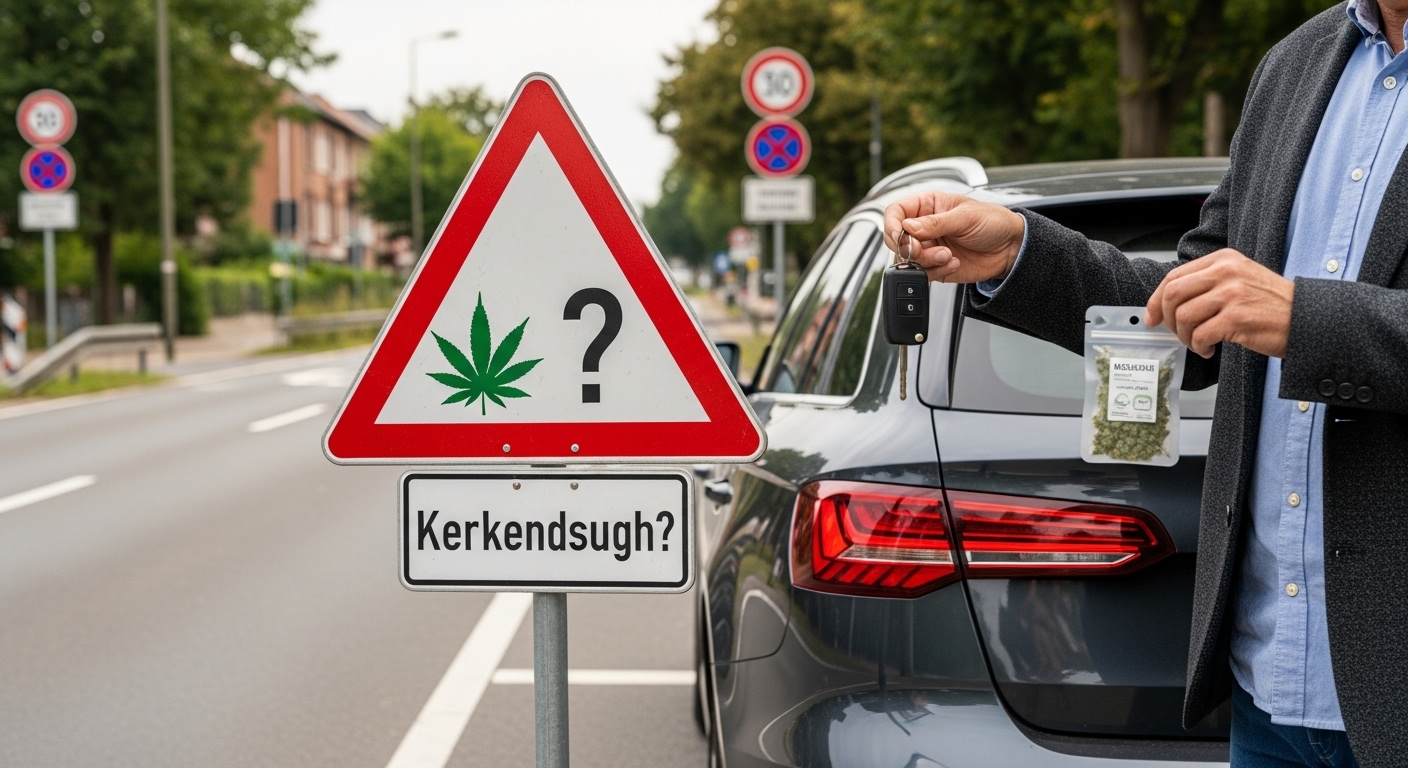
Combined use is considered to increase risk substantially. Authorities also examine whether consumption is occasional or regular. Repeated offences may lead to an MPU. It is therefore essential to consider not only the limit but also your own behaviour honestly.
Special rules for young drivers and the probationary period
The law is particularly strict for drivers under 21 and anyone in their probationary period. An effective zero-tolerance rule applies. Even the smallest residual amounts of THC can be treated as an offence. This reflects the fact that young drivers are statistically more frequently involved in accidents.
Lawmakers therefore take a particularly cautious approach. In addition to fines, affected drivers often face measures relating to their probationary period, such as remedial courses or an extension. A single mistake can therefore quickly become very expensive and have lasting consequences.
Individual elimination times and the absence of a fixed waiting period
A key point is that there is no universal waiting period after consumption. THC elimination varies from person to person. Relevant factors include body fat percentage, metabolism and frequency of use.
Regular users may remain above the limit even days later, making assessment particularly difficult. Some users no longer feel intoxicated but still have measurable levels above 3.5 ng/ml. It is therefore impossible to say “You are safe after 24 hours”. Only clear abstinence before driving offers real certainty.
Recognising intoxication during roadside checks
Alongside laboratory values, police look for outward signs. These include altered pupils, slowed reactions or uncertainty when speaking. Unusual driving manoeuvres also attract attention quickly. Police frequently use rapid tests for an initial assessment.
A positive result leads to a blood sample being ordered. This forms the legal basis for penalties. Even if the value is just below the limit, obvious intoxication can cause problems. Your own perception is therefore an unreliable guide.
Recommendations for safe road use
The safest rule is to drive only when you feel completely clear-headed. However, regular consumption makes it difficult to assess levels correctly. If you are unsure, do not drive.
Traffic psychology or legal advice can also help you understand the risks. These services provide guidance if traffic incidents have already occurred and explain possible MPU requirements. This allows you to demonstrate responsibility and avoid long-term disadvantages.
The new threshold and penalties
Since 22 August 2024, the question “When can you drive after using cannabis?” has been addressed by a new statutory THC limit of 3.5 nanograms per millilitre of blood serum (ng/ml). Exceeding this value is an administrative offence.
This limit is intended to ensure that penalties apply only to driving with relevant impairment. An offence generally results in a €500 fine, two points in Flensburg and a one-month driving ban, with substantially higher penalties for repeat offenders.
Strict “zero tolerance” for special groups
Although the general THC limit has been raised to 3.5 ng/ml, strict zero tolerance applies to certain groups: cannabis use in connection with driving is effectively prohibited for drivers under 21 and all drivers still in the two-year driving licence probationary period.
For these drivers, detecting even the smallest amounts of THC in the blood leads to penalties and the risk of an MPU. This rule aims to give special protection to young and inexperienced drivers and ensure a high level of road safety before they drive after cannabis use.
The ban on combining THC and alcohol
Anyone considering driving after cannabis use must strictly avoid combined consumption. The new legislation provides for an absolute alcohol ban when driving a motor vehicle under the influence of THC.
This means that even small amounts of alcohol below the 0.5-per-mille limit drastically increase the penalty when THC is also detected. In repeat cases, this can quickly lead to a €1,000 fine and a longer driving ban.
Conclusion
Driving after cannabis use is permitted only when there is no intoxication and the THC limit is observed. The rules are strict, and even small mistakes can bring substantial costs and driving bans. Young drivers face particularly significant restrictions. Since elimination times vary greatly between individuals, caution is the most important principle. To be safe, drive sober or leave the car behind. This avoids penalties and protects you and other road users.
Sources:
- ADAC: New THC Limit – The Rules for Cannabis and Driving
- DEKRA Road Safety: Cannabis Use and Driving
- Rightmart: Cannabis Legalisation and Driving – The Rules
FAQ
When can you drive after cannabis use under the new law?
You may drive after cannabis use as long as the concentration of active THC in your blood serum is below the new limit of 3.5 nanograms per millilitre (ng/ml). This limit applies to all drivers over 21 who are no longer in their probationary period.
What does the limit of 3.5 ng/ml of THC in blood serum mean?
The value of 3.5 ng/ml is regarded as the point at which impairment of driving safety can no longer be ruled out. It corresponds roughly to the effect of a blood alcohol concentration of 0.2 per mille.
How long must I wait after consumption before driving again?
Experts strongly advise waiting at least 24 hours after occasional cannabis use to ensure levels are below the limit. With regular consumption, active THC can remain in the blood considerably longer, increasing the risk of an offence.
Do the new rules also apply to novice drivers and people under 21?
No. A strict zero-tolerance limit continues to apply to novice drivers in their probationary period and people under 21. Detecting even the smallest amounts of THC leads to penalties for these drivers, regardless of the new limit.
May patients prescribed medical cannabis drive?
Yes. Patients may drive if cannabis has been medically prescribed and their medication regimen is stable. The requirement is that taking it does not cause acute impairment of their ability to drive.
What penalty applies to a first offence above the limit?
A first offence exceeding the 3.5 ng/ml THC limit is generally punished with a €500 fine, two points in Flensburg and a one-month driving ban. Repeat offences bring significantly higher fines and longer bans.
May I carry cannabis in a car even if I am not driving?
Yes. Since legalisation, adults may carry cannabis in a car within the legally permitted quantity of up to 25 grams. It is important that it is inaccessible to children and not immediately within reach, to avoid allegations of consumption while driving.
Is combining cannabis and alcohol when driving permitted?
No. Combining THC and alcohol when driving is absolutely prohibited, even if each individual value is below its respective limit. This leads to harsher penalties because combined use significantly increases accident risk.
Is only the THC level measured during a roadside check?
A check initially involves a rapid drug test, such as a saliva test, that responds to THC. If positive, it is followed by blood sampling to determine the active THC level in blood serum in a legally admissible way.
When is an MPU ordered despite the new limit?
An MPU, or medical-psychological assessment, is generally ordered following repeated exceedances of the 3.5 ng/ml limit or additional evidence of misuse or dependence. The driving licence authority then assesses overall fitness to drive.