

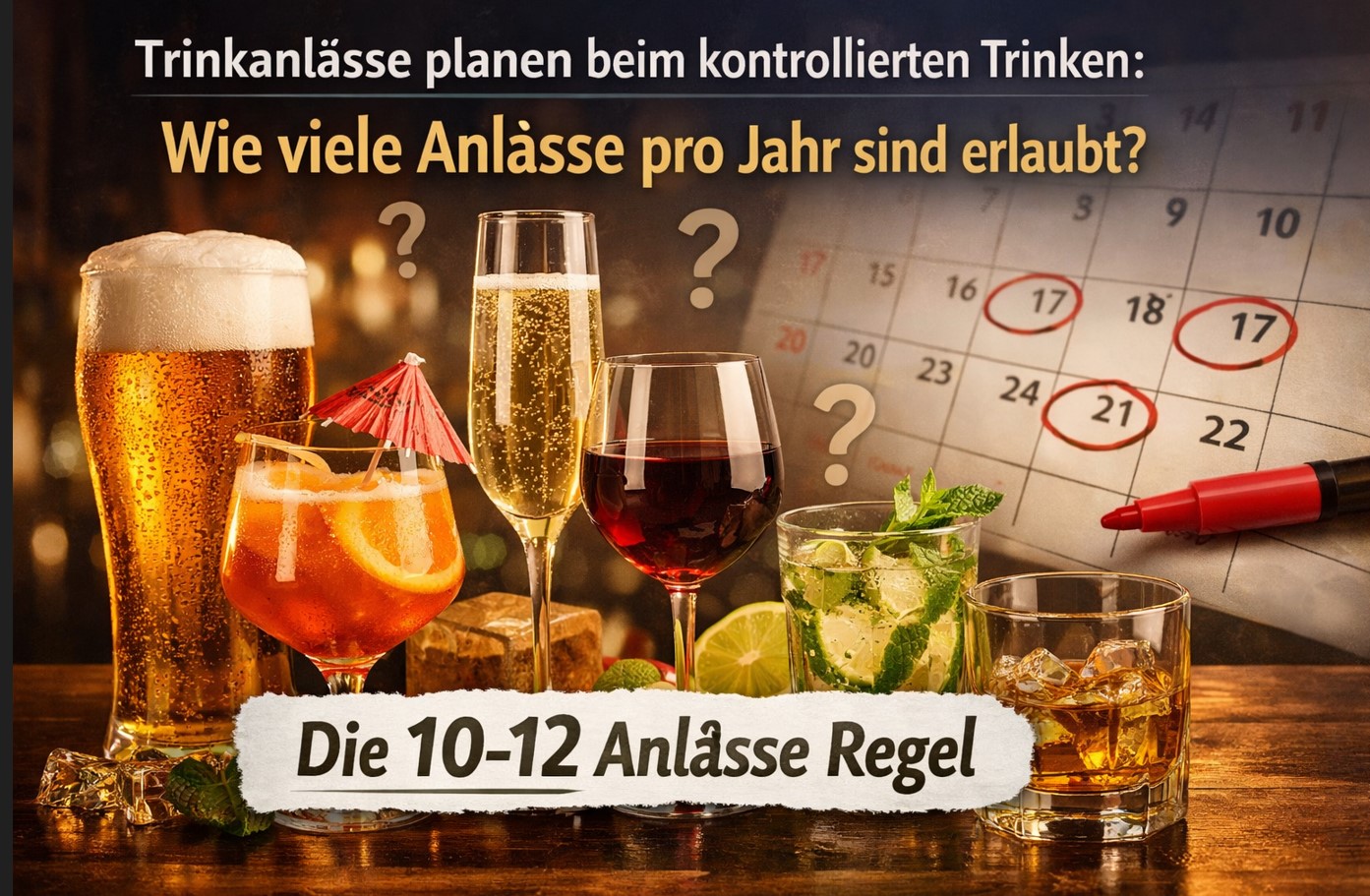
Controlled drinking for an MPU appears straightforward at first glance. In practice, however, much depends on a clear, credible structure. This is why the rule of thumb “a maximum of 10–12 drinking occasions per year” is frequently used. This corresponds roughly to one occasion per month, with several weeks between them. Importantly, this limit is not law. It is an established guide from assessment practice. Assessors often regard it as a minimum standard for infrequent, planned alcohol consumption. Understanding this reasoning and documenting it properly significantly improves your chances.
Key points at a glance
- A frequently used rule of thumb is a maximum of 10–12 drinking occasions in 12 months: infrequent and planned.
- There should usually be at least three to four weeks between occasions. Spontaneous drinking is viewed critically.
- The rule is not written into law but is a practical guide often treated as a minimum standard.
- Consistency is crucial: the drinking diary, personal account and evidence must agree.
- Whether 10, 12 or fewer occasions are “enough” depends on the overall picture. Some centres favour even less frequent drinking or recommend abstinence.
How many drinking occasions per year are considered acceptable for controlled drinking in the MPU?
A frequently cited guide is “a maximum of 10–12 drinking occasions per year”, ideally planned and separated by at least three to four weeks, because more frequent or spontaneous consumption weakens credibility.
What the 10–12-occasion rule of thumb really means
The rule of thumb “a maximum of 10–12 drinking occasions per year” describes infrequent, consciously managed alcohol consumption. Its aim is for drinking no longer to appear routine but to remain clearly limited. It does not mean that exactly 12 occasions are “optimal”.

It is a guide often understood in practice as a minimum standard. It is also important to note that the rule is not legally prescribed. Rather, it has become established in MPU practice. Assessors use it to judge whether controlled drinking is realistic and consistently practised.
The key points of the rule of thumb
| Point | What it means | Why it matters |
|---|---|---|
| Maximum 10–12 occasions per year | Approximately one occasion per month | Greater frequency otherwise resembles habitual drinking |
| Infrequent and planned | Occasions are determined in advance | Demonstrates control and risk management |
| Not law | A practical guide, not a statutory provision | Assessors nevertheless use it in their evaluations |
| Minimum standard | Often the minimum expectation for “infrequent” drinking | More consumption weakens the case |
Why a gap of three to four weeks matters so much
There should generally be at least three to four weeks between two drinking occasions. This interval is more than a number. It is intended to show that alcohol has no fixed place in everyday life. It also helps break spontaneous patterns. Drinking again after a short time can quickly appear driven by an urge or suggest an unclear behavioural change.
Assessors also examine rhythm and regularity. A clear interval is therefore often more credible than an inconsistent pattern. The more consistently you maintain the gap, the more stable your controlled-drinking approach appears.
Intervals and their effect in the assessment
| Interval between occasions | Typical impression in an MPU | Risk of doubt |
|---|---|---|
| 3–4 weeks or more | Appears planned and infrequent | Low |
| 2 weeks | Appears substantially more frequent | Medium |
| A few days / spontaneous | Appears uncontrolled | High |
Planning rather than spontaneity: the foundation of credibility
Spontaneous drinking is considered problematic in an MPU because it can appear to be a return to old patterns. Planning is therefore a key concept in controlled drinking. It shows that you decide beforehand rather than in the moment.
This applies to the occasion, timing and amount. Planned drinking is also easier to document, making your personal account understandable. In an MPU, this traceability is often the difference between “sounds good” and “is credible”.
Planned versus spontaneous drinking
| Feature | Planned drinking | Spontaneous drinking |
|---|---|---|
| Decision | Determined in advance | Situational and impulsive |
| Interval | Consciously maintained | Often irregular |
| Documentation | Easy, clear and complete | Incomplete or retrospective |
| Effect in the MPU | Supports a controlled approach | Weakens credibility |
Evidence in the MPU: drinking diary, personal account and consistency
The number of occasions must match your evidence, particularly your drinking diary and personal account. Discrepancies quickly appear unconvincing. Even small contradictions may be interpreted as glossing over the truth.
A clear, consistent picture is therefore needed across the entire period. Other evidence must also fit, including statements made during the interview that form part of your history.
What matters is not merely what you say, but whether everything is coherent. Consistency demonstrates stability, and stability is a core MPU criterion.
A consistency check for your documents
| Area | What must be consistent | Typical pitfall |
|---|---|---|
| Drinking diary | Date, occasion, interval and frequency | Gaps or entries that appear to have been added retrospectively |
| Personal account | The same reasoning as the diary | Different figures from those in the diary |
| Interview with the assessor | The same history and rules | Details change under further questioning |
| Overall picture | Behaviour appears permanently changed | “Exceptions” become frequent |
The individual case decides: other factors assessors examine
Whether 10, 12 or fewer occasions are “sufficient” depends on the overall picture. This includes your history and offence. Risk factors also matter, as does the stability of your behavioural change.
Some assessment centres view controlled drinking more critically than others. Some favour even less frequent drinking. Others explicitly recommend abstinence when the history is serious. The rule of thumb is therefore not a free pass. It is a framework that works only if the rest of your account is equally stable.
Factors influencing the assessment
| Factor | Why it matters | Possible consequence |
|---|---|---|
| History | Shows patterns and risk | Stricter expectations of stability |
| Offence / reason for the MPU | Determines the risk situation | Possible recommendation of abstinence |
| Risk factors | For example, past loss of control | Fewer occasions or abstinence may be necessary |
| Stability of the change | Duration and consistency | Determines credibility |
| Assessor’s judgement | A practical assessment | May be stricter or more lenient |
Common controlled-drinking mistakes and how to avoid them
A common mistake is drinking too frequently, even if the amount is “small”. Frequency can carry more weight than individual quantities. Another mistake is spontaneous drinking because it resembles old automatic habits. Changing rules are also problematic.
One approach today and another tomorrow does not sound stable. Many people also underestimate consistency in their documents. If the drinking diary and personal account do not match, mistrust arises. Avoid “exceptions” that suddenly become habits. A clear, simple set of rules maintained over a long period and documented properly is better.
Here is the detailed analysis and the optimisation suggestions for your URL on “Planning Drinking Occasions for Controlled Drinking”.
Weekly structure and alcohol-free days
An effective controlled-drinking plan covers more than just 12 annual occasions. Leading MPU experts advise setting weekly targets as well, such as the number of completely alcohol-free days per week, at least 5 to 6.
This shows the assessor that planning drinking occasions is embedded in a stable daily routine and that alcohol has no fixed place in that routine. Capping total weekly consumption also demonstrates thorough control over your behaviour.
This detailed planning complements the 10–12-occasion rule and substantially increases the credibility of your behavioural change.
Preventing tolerance through strict intervals
When planning occasions for controlled drinking, distribution is more important than the number alone. There must be a break of 4 to 6 weeks between individual occasions so that your body does not become accustomed to alcohol again.
The 10–12-occasion rule primarily aims to prevent gradually developing tolerance. Grouping several occasions into one month, for example at Christmas, could be interpreted by an assessor as an unstable pattern.
Plan ahead and ensure that every drinking occasion remains an isolated event surrounded by long periods of abstinence.
Objective evidence through medical parameters: CDT and liver tests
Anyone using planned drinking occasions as a strategy should support its credibility with medical facts. Although controlled drinking does not require forensic screening in the same way as abstinence, assessors often request additional laboratory data such as CDT or regular liver tests.
These values act as a “lie detector”, because they would immediately rise if the 10–12-occasion rule were exceeded or the amounts per occasion were too high. Voluntarily presenting these findings every one to two months ideally supports your written drinking calendar.
This signals complete transparency and a professional approach to the assessment centre, significantly improving your chances of a favourable report.
Conclusion
The 10–12-drinking-occasion rule is an important guide in an MPU, but not law. It represents infrequent, planned drinking with clear intervals and no spontaneous slips. The crucial point is that your approach remains stable for months and matches your drinking diary and personal account. At the same time, the individual case matters. Your history, offence and risk factors may lead to stricter standards. Understanding and consistently applying the rule supports credibility.
Sources:
- Controlled Drinking for the MPU – Is It Sensible?
- Controlled Drinking in the MPU – Alcohol Consumption 2025
- Controlled Drinking MPU 2026: Requirements and Prospects
FAQ
What is the 10–12-occasion rule for controlled drinking?
The rule states that alcohol may be consumed on no more than 10 to 12 special occasions each year. Its aim is to treat alcohol purely as something to enjoy and consistently prevent physical habituation.
How many drinking occasions per month are allowed?
On average, only one planned drinking occasion per month is permissible to demonstrate behavioural stability. Several occasions in one month should be avoided because they could indicate an unstable consumption pattern.
Can you drink spontaneously with controlled drinking?
No. Spontaneous consumption is strictly prohibited in controlled drinking and is regarded in an MPU as a sign of insufficient control. Every occasion must be planned at least several days in advance and entered firmly in a calendar.
What blood alcohol limit applies to a single drinking occasion?
On a planned occasion, a blood alcohol concentration of 0.3 per mille, or at most 0.5 per mille, should never be exceeded. This generally corresponds to a small standard drink, such as 0.33 l of beer or 0.2 l of wine.
How long must controlled drinking be demonstrated?
For a successful MPU, controlled drinking generally needs to have been practised consistently for at least six months. In some cases, the assessor requires documentation covering a full twelve months.
Is a drinking diary sufficient evidence for the MPU?
A drinking diary is important evidence but should ideally be supplemented by medical findings such as liver tests or CDT levels. These medical parameters strongly support the credibility of your statements to the psychological assessor.
Can everyone pass the MPU with controlled drinking?
No. With diagnosed alcohol dependence, controlled drinking is not an option and strict abstinence is essential. It is primarily suitable for people with alcohol misuse or elevated risk without symptoms of dependence.
Why must there be a long break between occasions?
Long breaks of at least four weeks prevent the brain from developing or maintaining tolerance to alcohol. They also demonstrate to the assessor that you can manage without alcohol for extended periods without difficulty.
What happens if you report more than 12 occasions per year?
Reporting more than 12 occasions risks the assessor classifying your consumption as risky rather than “controlled”. Excessive frequency often suggests that enjoyment has not yet been fully separated from everyday life.
Must alcohol-free days also be planned with controlled drinking?
Yes. It is strongly recommended to include at least five to six completely alcohol-free days per week firmly in your consumption plan. This demonstrates clear structure and prevents drinking from becoming an everyday habit.